Humanoids Are Entering Their Test-Track Era
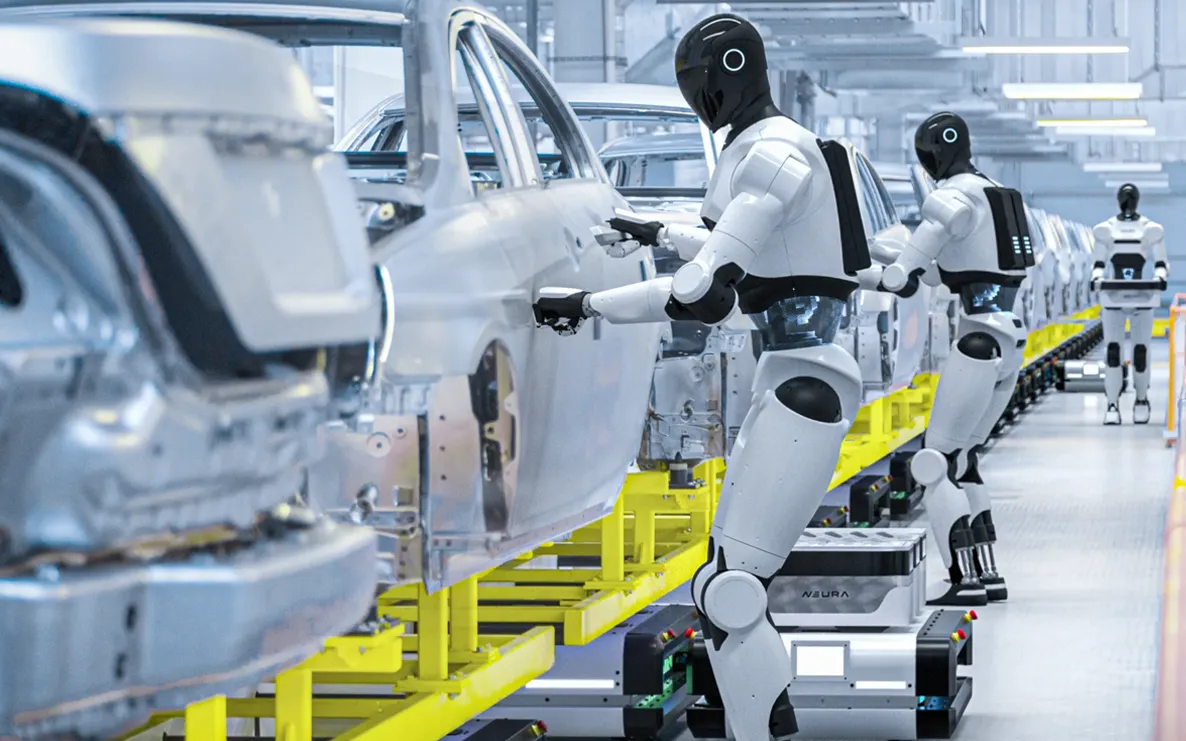


Image credit: Neura Robotics - Humanoids in real Automotive Assembly
Why the next race is validation infrastructure, not robot launches
The humanoid market is changing shape. Until recently, the category was dominated by launch videos, prototype demos and headline-grabbing promises. The clearest signal now is different: humanoid robots are starting to get their own test tracks. In March, Reuters showed Beijing’s Robotics Pilot Testing and Validation Platform in operation, with humanoid robots on production lines, test rigs and treadmills. Earlier this year, the International Federation of Robotics said the next hurdle for industrial humanoids is proving reliability and efficiency in real applications, not just demonstrating capability.
That matters because it marks a shift from prototype culture to validation culture. In mature industries, a technology is not truly commercial because it looks impressive in a demo. It becomes commercial when it can survive endurance testing, quality gates, maintenance cycles, safety reviews and repeated deployment under controlled conditions. Humanoids are now entering that phase. The IFR’s 2026 trends note is unusually direct: humanoid robots for industrial use must prove reliability and efficiency if they are going to compete in environments such as manufacturing and warehousing.
The strongest industrial signals point the same way. BMW has launched its first European humanoid pilot at its Leipzig plant, explicitly tying the project to production of cars, batteries and components. Hyundai has said it plans to deploy humanoid robots at its Georgia plant from 2028 and build capacity to manufacture 30,000 robot units annually. Mercedes-Benz’s commercial work with Apptronik has already pushed the market toward structured manufacturing trials. That is not “cool robot” news. It is evidence that humanoids are entering a market where deployment proof will matter more than novelty.
The result is a new strategic question for the sector: who is building the best robot, and who is building the best proof system? In the next phase of the market, those may not be the same company. The winners will be the platforms that can show hard evidence on uptime, intervention rates, maintainability, recovery from faults, software stability and safe operation in human-designed environments. That is what turns a humanoid from a demo into an industrial asset.
The Beijing testing hub is more than a striking visual. It is a symbol of how the category is maturing. When a sector starts building dedicated validation platforms, it usually means the conversation has moved from “can it be done?” to “can it be repeated, measured and trusted?” Reuters’ footage of humanoids moving on treadmills, operating in test areas and being remotely controlled points exactly in that direction.
This is where humanoids begin to resemble more evolved industries. Automotive was not scaled by great concept cars alone. It was scaled through testing, launch discipline, supplier qualification and repeatable quality control. The same pattern is emerging here. BMW’s move into Leipzig is important not just because it is using a humanoid, but because it is putting that platform into a real production context inside a major industrial organisation.
A new humanoid model can generate attention. Validation generates trust. And trust is what buyers, insurers, integrators and funders need before a category scales.
The IFR’s framing is helpful because it strips away the hype. It identifies humanoids as promising for environments designed for humans, especially where flexibility is required, but says they still need to prove industrial-grade reliability and efficiency. That means the core market questions for 2026 are changing. Not: how fluidly can it move in a keynote clip? But: how many interventions does it need in a shift? What happens after a fault? How stable are software updates? How long does recovery take? How much technician support is required?
That is also why automotive remains the most useful reference market. BMW, Hyundai and Mercedes-Benz are not treating humanoids as novelty projects. They are treating them as potential production tools, which means the standard for success immediately becomes harder: safety, maintainability, operator acceptance, and consistency under load.
The next phase of the market will be defined by what could be called a humanoid validation stack. That stack is not a single standard yet, but the industry is clearly moving toward it.
First, there is endurance validation. Platforms will need to show that they can operate for meaningful periods under industrial conditions, not just perform short demonstration tasks. Reuters’ imagery of treadmill testing is one visible sign that endurance and repeatability are becoming central.
Second, there is application-specific validation. A humanoid that works in one controlled setting may fail in another. BMW’s Leipzig pilot matters because it is tied to actual production use cases in cars, batteries and components, not a generic robotics sandbox.
Third, there is serviceability validation. Industrial buyers will increasingly ask about spares, maintenance intervals, field support, recovery procedures and software management. Hyundai’s plan to industrialise Atlas at meaningful annual capacity is significant precisely because scale ambitions imply support infrastructure, not just robot output.
Fourth, there is operational validation. That means tracking intervention rates, uptime, safe-stop behaviour, and post-failure recovery. The IFR’s emphasis on reliability and efficiency is really a call for this kind of operational evidence.
For UK operators, warehouses and manufacturers, the immediate lesson is simple: the right question is no longer “which humanoid looks most advanced?” It is “which platform is being validated in a way that resembles industrial reality?”
That leads to a better procurement approach. Ask the OEMs how their systems are tested, not just what they can do. Ask what evidence exists from endurance runs, intervention logs, maintenance cycles and deployment recoveries. Ask what support structure sits behind the machine. Ask how software changes are handled once the robot is on site. In a market moving from launch culture to validation culture, those answers will tell you more than any demo reel.
For funders and commercial partners, the same logic applies. A humanoid category that is beginning to build validation infrastructure is also a category moving closer to financeable deployment. As the evidence base strengthens, more pilots should become structured rollouts rather than dead-end experiments.
The most important humanoid news this week is not a product reveal. It is the appearance of the systems that make product reveals matter less. Testing hubs, production pilots, reliability benchmarks and endurance proof are how a technology stops being interesting and starts becoming useful.
That is why this moment matters. The humanoid sector is moving from launch culture to validation culture. And once that shift takes hold, the competitive landscape changes. The category leaders of the next few years may not be the companies with the flashiest videos. They may be the ones with the strongest proof.