Humanoid Robots Are Entering Real Industry. Which Ones Will Actually Scale?
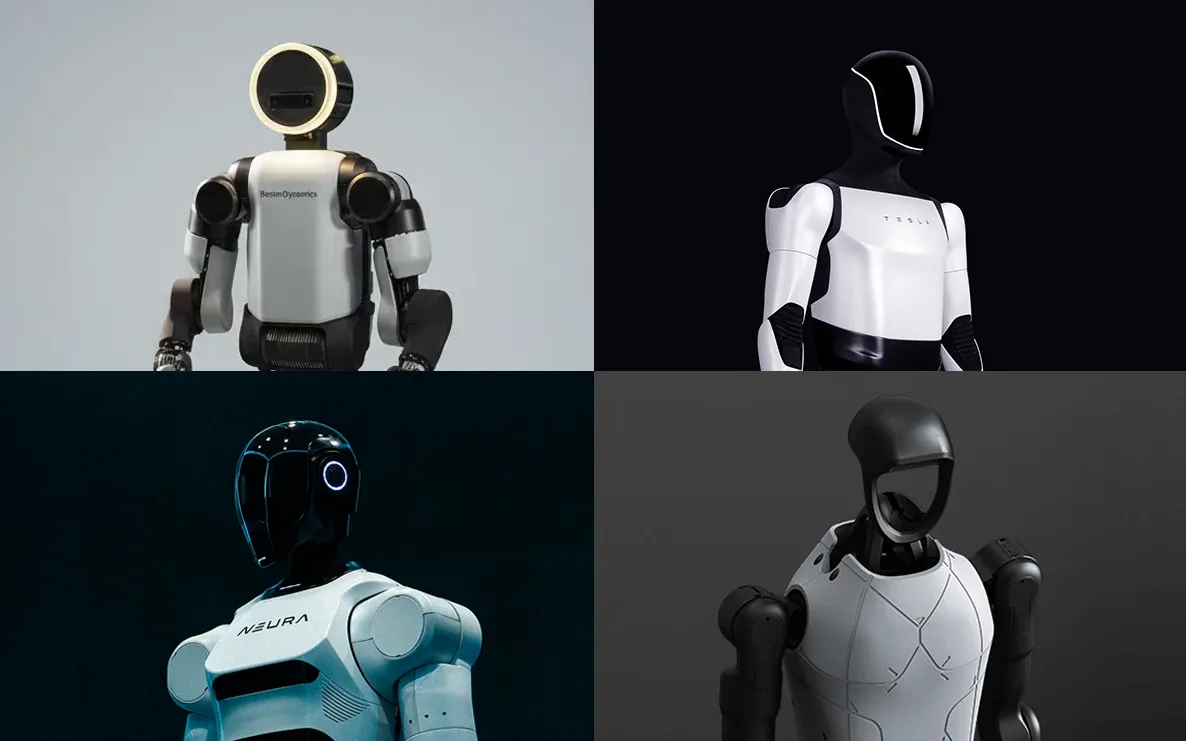


Humanoid robots are no longer just a speculative future story. In January, Gartner said fewer than 100 companies will move humanoid proofs of concept beyond experimentation by 2028, and fewer than 20 will reach live production in manufacturing and supply chain use cases. Gartner’s view is blunt: most deployments will remain confined to tightly controlled environments rather than dynamic, high-throughput operations.
And yet the industrial signals keep strengthening. Reuters reported on 13 March that STMicroelectronics has already deployed its first humanoid and plans more than 100 robots for repetitive and physically intense tasks in older semiconductor plants. The Wall Street Journal reported today that Agility Robotics’ Digit is working in a Schaeffler factory for up to eight hours a day, although still under controlled conditions and contractor monitoring.
That tension is the real humanoid story in March 2026. The market is no longer asking whether humanoids can exist in industry. It is asking what must be true for them to move beyond pilots and into repeatable, operational use at fleet level.
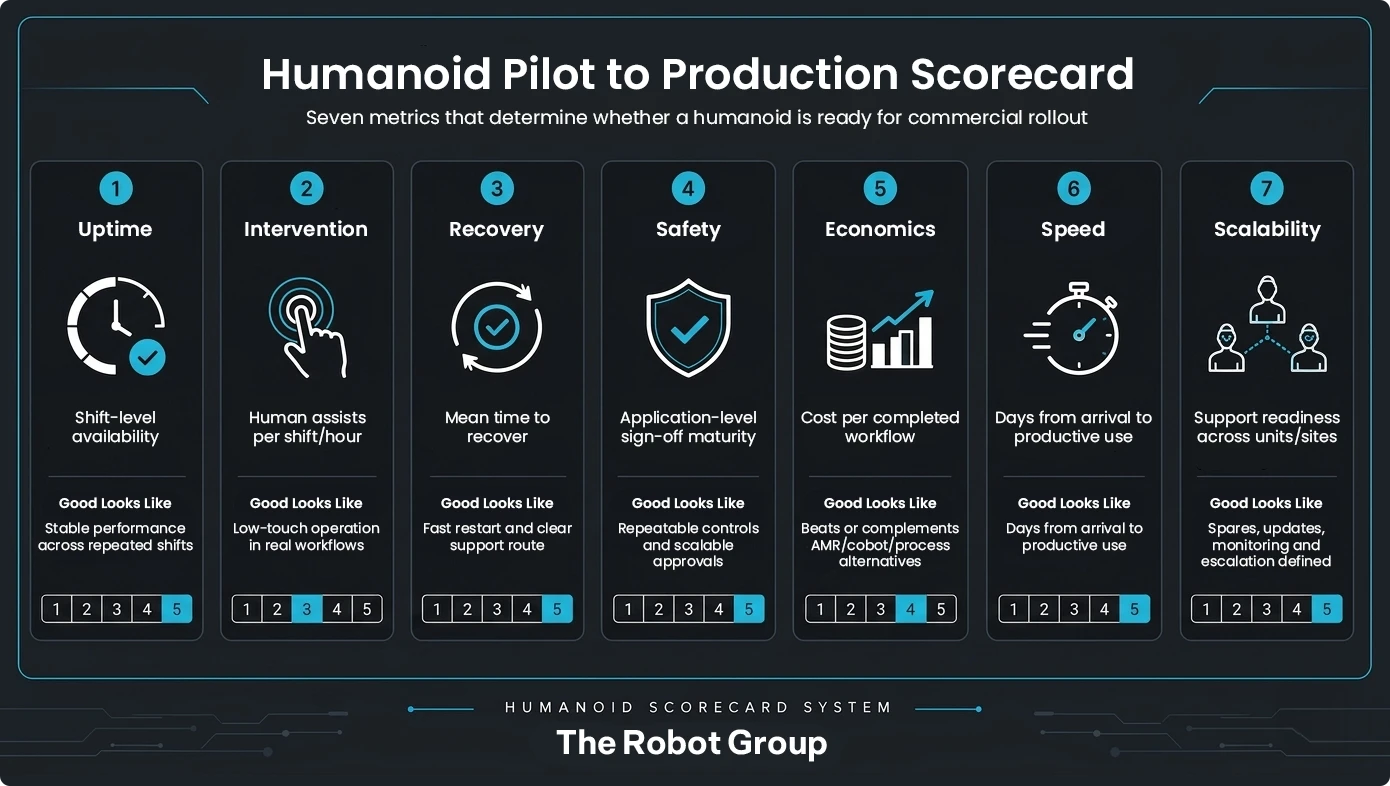
At The Robot Group, we think the answer is best understood through seven operational metrics. These are the measures that journalists, consultants, investors, OEMs, and operators should be using right now when they ask whether humanoids are becoming real capital equipment or staying stuck as expensive experiments.
The first test is simple: can the robot stay productive through a real shift, under real site conditions, without becoming a support burden? The International Federation of Robotics said in January that humanoids now need to prove reliability and efficiency for industrial use, including on cycle times, energy use, and maintenance costs. That is the right lens. A machine that performs well in short demonstrations but struggles across repeated shifts is still a pilot-stage asset.
A humanoid does not fail only when it stops moving. It also fails when operators constantly need to rescue it, reposition it, or finish the job themselves. This is one of the clearest hidden costs in early deployments. Gartner’s warning that most production use will stay in tightly controlled environments is, in practice, a warning that intervention rates are still too high for broad rollout.
Industrial teams can tolerate issues. What they cannot tolerate is slow recovery. That is why spare parts, remote diagnostics, service response times, software rollback, and swap-unit policies matter so much. IFR’s emphasis on maintenance costs and efficiency points directly to this: if recovery is slow, the economics quickly collapse.
The market often asks what humanoids can do. Industrial buyers should ask where they can work, under what controls, and with what level of human proximity. The Wall Street Journal’s reporting on Digit at Schaeffler is revealing because the robot is still operating under safety constraints, with future models expected to improve human-detection capabilities for freer coexistence with workers. That is what pilot-stage maturity looks like: useful, but not yet frictionless.
Humanoids do not scale because they are general-purpose. They scale when they outperform the real alternatives on a defined task. IFR says humanoids are promising where flexibility is required in environments designed for humans, especially in warehousing and manufacturing. That is important, but the real comparison is not “humanoid versus human” in the abstract. It is “humanoid versus AMR versus cobot versus process redesign” on the exact workflow being considered.
A robot that takes too long to install, tune, safety-approve, and stabilise will struggle to scale, even if it eventually works. This is why the strongest early humanoid use cases are emerging in structured industrial environments. Reuters’ STMicro report points to repetitive and physically intense tasks in existing semiconductor plants, not open-ended science-fiction roles. That is a classic sign of a category moving toward real deployment logic.
One successful unit proves curiosity. A fleet proves a category. The real threshold for 2026 is whether operators and vendors can support multiple humanoids across shifts, sites, and eventually regions. STMicro’s plan for more than 100 robots matters not just because of the number, but because it forces the market to confront the real scaling question: how do you support, govern, maintain, and justify that many units operationally?
Put the current evidence together and the picture is clearer than the headlines suggest. Gartner is right to warn that most humanoids will stall before broad production deployment. IFR is right that reliability and efficiency are now the decisive hurdle. Reuters is right that serious manufacturers are already moving ahead with real robots in real plants. And the Schaeffler example shows both truths at once: humanoids are here, but the constraints are still real.
This is why the best question in humanoids today is not “Which robot is best?” It is: what evidence would convince a serious operator to scale from one pilot to ten sites? That is the question press, researchers, and consultants are all trying to answer right now.
The next winners in humanoids will not be the companies with the best demo clips. They will be the companies that can answer seven simple questions with evidence: Can the robot stay up? How often does it need help? How fast can it recover? Can the safety case scale? Do the task economics work? How long does commissioning take? Can the fleet actually be supported? That is the pilot-to-production test.
If you’re evaluating humanoid robots for a warehouse, factory, or industrial site, this is the scorecard worth using before you commit budget, operational time, or internal credibility.
Humanoid robots are now entering the phase where operational proof matters more than headlines. The businesses that win won’t be the ones chasing the most impressive demo - they’ll be the ones using clear metrics to decide what is genuinely ready for deployment. If a humanoid platform can meet the pilot-to-production test on uptime, intervention rate, recovery, safety, economics, commissioning, and fleet support, it moves from curiosity to credible industrial asset.
And that is the real question the market is trying to answer in 2026.