What Humanoid Robot Is Right for My Business?


Last updated: May 2026
The Robot Group (TRG) updates this guide periodically to reflect meaningful OEM, market and deployment changes in the humanoid robotics sector.
Most businesses start with the wrong question.
They ask: which humanoid robot is best?
But that is rarely the question that matters in practice. The better question is: which humanoid robot is right for our business, our site, and our first real use case?
That is a different decision entirely.
Because a humanoid that looks impressive in a demo is not necessarily the right choice for a live warehouse, manufacturing plant, or industrial workflow. The right choice depends on what you are trying to achieve, how your environment behaves, how much operational complexity you can absorb, and whether the robot is actually ready to move from pilot into repeatable production use.
For most UK businesses, the goal is not to find the most futuristic robot. It is to find the robot most likely to work in the real world, with the least friction and the clearest commercial path.
That means starting with the business, not the machine.
The first filter is always the workflow.
A humanoid should not be chosen because it is advanced, well-known, or recently announced. It should be chosen because it fits a task that is repetitive enough to justify automation, valuable enough to matter, and variable enough that simpler fixed automation may not be the better answer.
That usually means starting with a narrow operational wedge rather than a broad ambition. Internal handling, tote movement, kitting, line-side support, repetitive internal logistics, and simple multi-step workflows are all stronger early candidates than open-ended “general labour” expectations.
The businesses that get the most value from humanoids first are usually the ones disciplined enough to choose one or two real workflows and assess them properly.
A humanoid does not operate in abstraction. It operates in a real site with real constraints.
That means asking practical questions early. Is the environment structured or semi-structured? How predictable are routes, objects, handoff points and human movement? How much congestion exists? What are the lighting, floor, space and access conditions? How much supervision can the business tolerate during the early stages of deployment?
These questions matter because the best robot on paper may still be the wrong robot for your operating environment. A site that is highly repeatable and tightly controlled may suit one vendor profile very well. A messier, more variable environment may demand a different balance of mobility, manipulation and support.
The right fit is always a combination of robot and environment.
When buyers compare humanoids, they often focus too heavily on surface-level capability. How fluidly it moves. How human-like it looks. How dexterous the hands appear. Those things matter, but not as much as many people think.
For a real business, the more important questions are operational.
Can it run consistently across shifts?
How often does it need human intervention?
How quickly can it recover from faults?
How mature is the safety and sign-off story?
How long does it take to move from arrival to productive use?
Can the OEM support multiple units and multiple sites over time?
And does the task economics actually make sense versus alternatives?
Those are the questions that determine whether a humanoid is interesting, or actually useful.
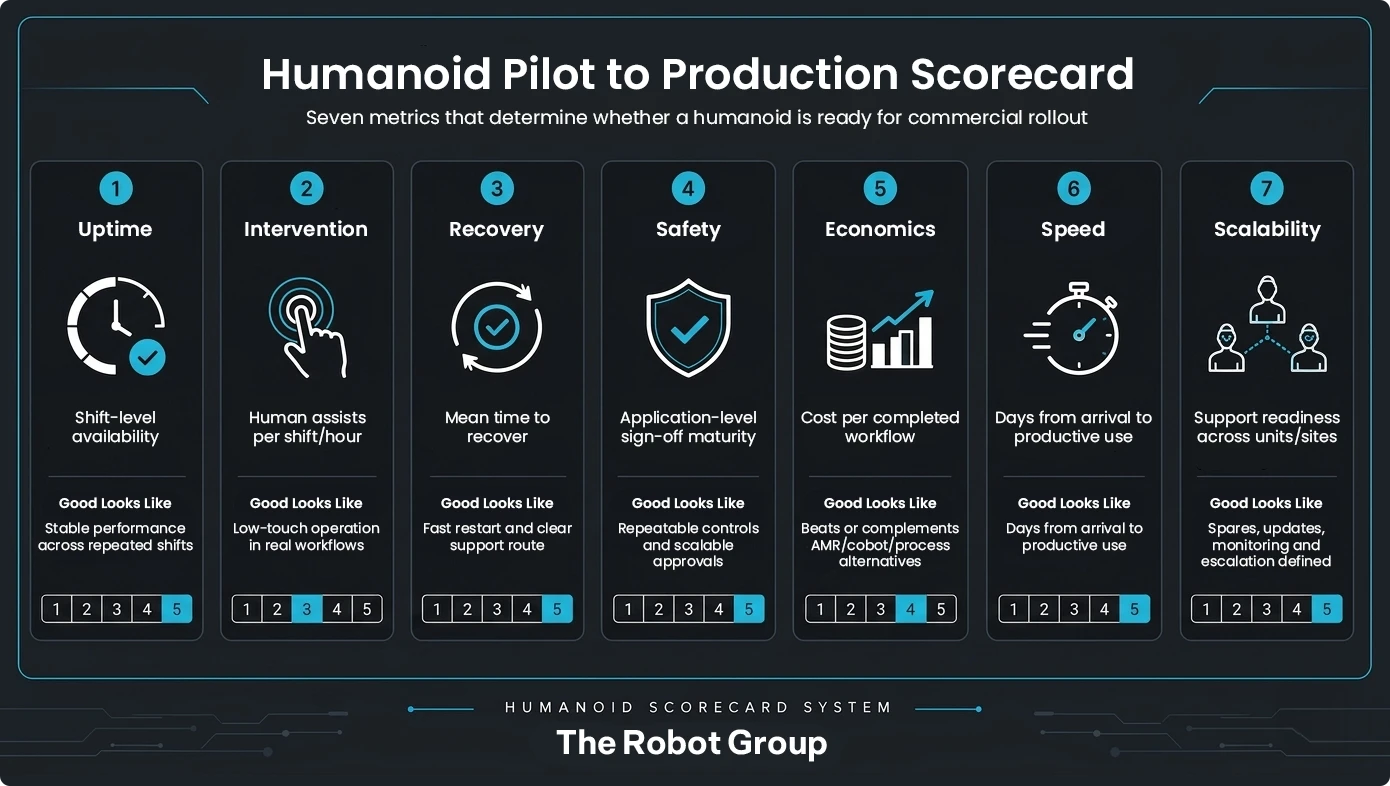
At The Robot Group, we use the same core scorecard to assess whether a humanoid is moving from pilot-stage promise into real industrial readiness. It is the framework behind our wider view of which humanoids are most likely to scale, and it is also one of the most practical ways for a buyer to compare which robot is right for their business.
That scorecard looks at seven things.
The first is uptime. A robot that can only perform in bursts is not a serious operational asset. The question is not whether it can do the task once. It is whether it can do it across repeated shifts with stable performance.
The second is intervention rate. Some robots may complete tasks, but only with constant human support. For a buyer, that changes the economics and the operating model completely. Low-touch operation matters more than polished demos.
The third is recovery. What happens when something goes wrong? A strong robot platform is not one that never fails. It is one that can recover quickly, cleanly and predictably, with a support model that makes sense for a live business.
The fourth is the safety case. This is not just about whether the robot has safety features. It is about whether the application can be signed off with confidence, whether controls are repeatable, and whether approvals can scale beyond a one-off pilot.
The fifth is task economics. This is one of the most overlooked areas. A humanoid is not the right choice if the workflow is already better solved by an AMR, a cobot, a process redesign, or conventional automation. The right robot has to improve or complement the economics of the workflow, not just participate in it.
The sixth is commissioning speed. Some platforms may be technically impressive but take too long to move from arrival to production use. Others may be easier to deploy repeatably. For businesses trying to pilot and scale, commissioning speed matters.
The seventh is fleet supportability. A robot might work as a single-unit pilot and still fail as a broader deployment. The real question is whether the OEM and support model are ready for multiple units, multiple sites, updates, monitoring and service continuity.
That is the underlying logic behind our Pilot to Production Scorecard, and it is equally useful as a buyer scorecard when comparing humanoids for first deployment.
The answer depends less on the robot’s brand and more on your priorities.
If you are an industrial or warehouse operator looking for the safest first move, the right humanoid is usually not the one making the boldest claims. It is the one that scores best against your first narrow workflow and your real deployment conditions.
If you care most about getting a first pilot live with minimal friction, then commissioning speed, support model and safety-case maturity may matter more than frontier-level dexterity.
If you care most about long-term rollout, then fleet supportability, recovery and uptime may matter more than early-stage novelty.
If your workflow is highly variable and requires movement plus manipulation in human-designed spaces, that will steer you toward a different profile than a buyer focused on tightly structured industrial handling.
That is why there is no single “best humanoid.” There is only a better fit for a specific use case and operating model.
For most buyers, the smartest first move is not to choose a robot. It is to choose a task.
Once the task is clear, the comparison becomes much easier. You can assess whether a humanoid is genuinely the right category, how demanding the environment is, what performance would count as success, and which OEM profile is most aligned with the reality of the deployment.
This also reduces the biggest risk in the market: buying too much promise and not enough readiness.
The humanoid market is still evolving quickly. OEMs will improve, support footprints will change, and new deployment evidence will emerge. That is exactly why businesses need a clear evaluation method rather than a gut-feel preference.
If you are exploring humanoids seriously, do not ask which robot looks most advanced.
Ask which robot is most likely to succeed in your first real workflow.
That means evaluating:
That is the purpose of the TRG 7-Metric Humanoid Scorecard, and it is why we use the same framework across our market analysis, buyer guidance and OEM evaluation.
Because in this market, the right robot is not the one with the biggest headline.
It is the one that gives your business the clearest route from interest to productive deployment.
If you want help assessing which humanoid is right for your business, The Robot Group can help you define the first use case, compare OEMs, and structure a pilot that is designed to scale if it works - speak to us today.