Humanoid vs AMR vs Cobot


If you’re evaluating automation in a UK warehouse or plant, the fastest mistake is starting with the robot type. Start with the task and the constraints - then choose the cheapest, safest machine that can do it reliably.
Here’s the practical way to think about it.
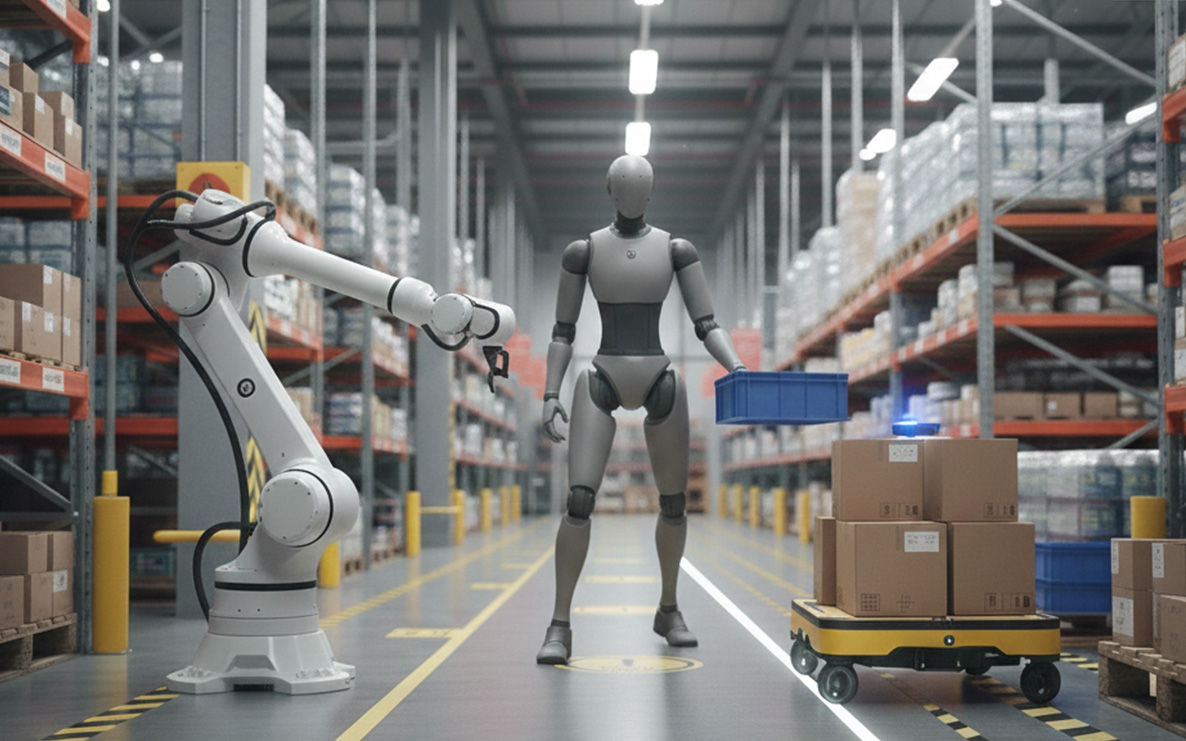
AMRs (Autonomous Mobile Robots) move things. They’re great at point-to-point transport, towing, and repeatable routes.
Cobots (collaborative robot arms) do precise work in one place. They’re great at pick-and-place, fastening, packing, dispensing, and machine tending - when the work area can be designed around them.
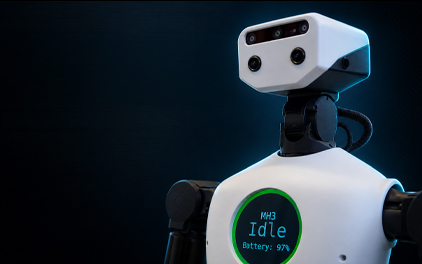
Humanoid Robots are generalists. Their advantage is not “being human”; it’s being able to operate in human-built environments with human tools, doing tasks that are awkward to redesign around fixed automation.
Humanoids robots are most compelling when all three of these are true:
1. The environment is built for people (and expensive to redesign)
If your site is full of existing racks, benches, carts, doors, manual stations, and tight walkways - and you can’t justify a major refit - humanoids can be attractive because they can work within that layout.
This is especially relevant in brownfield UK sites where the ROI case for ripping out and rebuilding isn’t there.
2. The task needs “reach + manipulation” across many stations
AMRs move; cobots manipulate in a fixed cell. Humanoids can potentially do mobile manipulation: moving to the work and interacting with objects at different heights, angles, and locations.
Examples where this can matter:
3. You need flexibility more than maximum speed
If your operation changes often - SKUs, packaging, station layouts, seasonal demand - humanoids can make sense because you’re buying adaptability, not peak cycle time.
A good rule: if your “perfect” automation solution would require you to redesign the process, retrain staff, and rebuild stations, a humanoid pilot can be a faster way to test value before committing to capital-heavy changes.
If the task is “move stuff A to B” and you can manage the handoff at each end, AMRs usually win on cost, maturity, and reliability.
AMRs shine for:
If you can solve your problem with AMRs plus better staging, you’ll typically get ROI sooner and with less risk than with a humanoid.
If the work happens at a predictable station and you can fixture parts or control presentation, cobots usually win.
Cobots shine for:
If you can create a stable cell, cobots deliver higher throughput and easier safety engineering than a humanoid doing the same manipulation while walking around.
Humanoids are most likely to win first in semi-structured work: not totally chaotic, not perfectly repeatable.
Think:
Humanoids are least likely to win early in:
Ask these questions in order:
1. Is the job mainly transport?
If yes, start with AMRs.
2. Is the job mainly manipulation at a fixed station?
If yes, start with a cobot cell.
3. Does the job require moving between stations and manipulating objects in human spaces with minimal site redesign?
If yes, humanoids may be the right pilot.
4. How often does the task change?
If it changes weekly/monthly, humanoids gain value. If it’s stable for years, fixed automation often wins.
If you decide humanoids might fit, run a pilot that produces a clear decision.
Pick 1–3 tasks and write acceptance criteria up front:
Then time-box it (typically around 90 days with one extension only).
Treat humanoids as part of a broader automation toolkit, but use them where they’re uniquely strong: mobile manipulation in human-designed environments where flexibility is worth more than raw speed.
If you’re considering a humanoid pilot in a warehouse or plant, The Robot Group can help you select the right first tasks and define an acceptance-gated pilot plan that’s designed to scale if it works.