One Intelligence. Built to Adapt: Inside Galbot’s Embodied AI Strategy
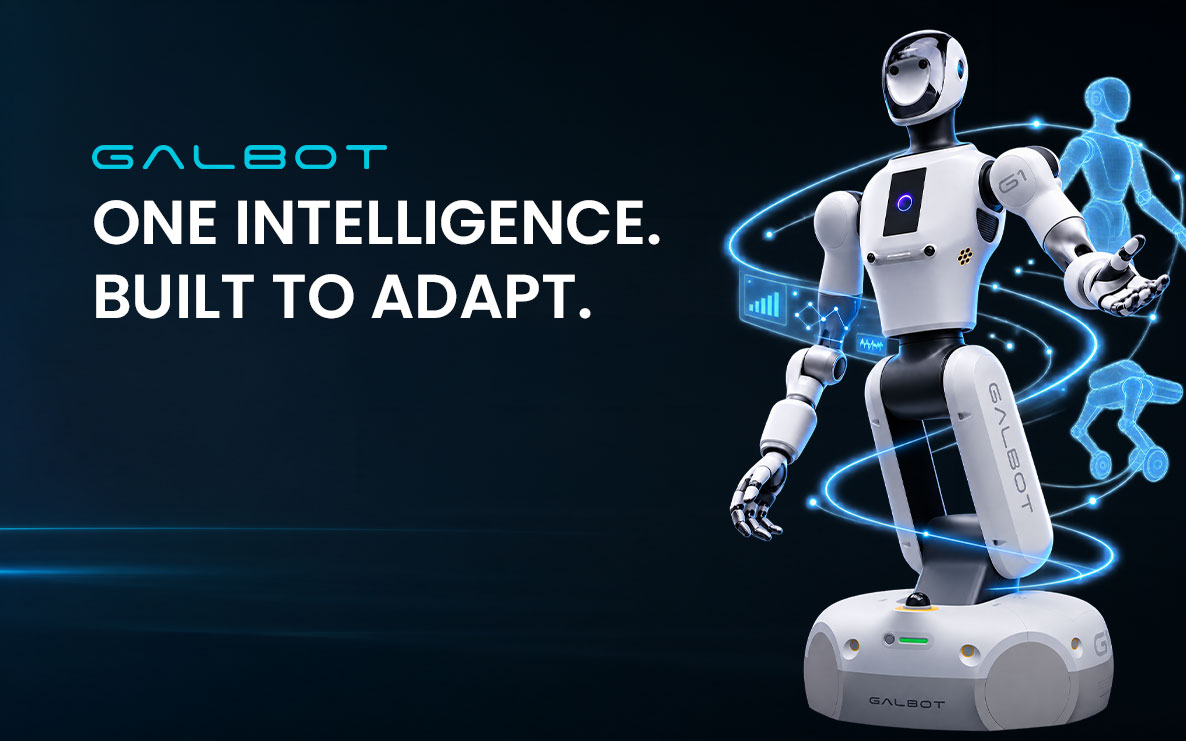


Galbot’s S1 and G1 already present a strong hardware proposition: practical mobile-manipulation platforms designed around useful work.
What makes the wider Galbot story particularly interesting is the intelligence being built underneath them.
Its research increasingly spans different forms of human and robot data, different end effectors and even different robot bodies. Alongside its current wheeled platforms, Galbot-affiliated research is also pushing into whole-body control on legged humanoids.
The result points towards a bigger idea:
the robot body can change, while the intelligence becomes increasingly transferable.
For businesses, that could ultimately matter more than the debate over wheels versus legs.
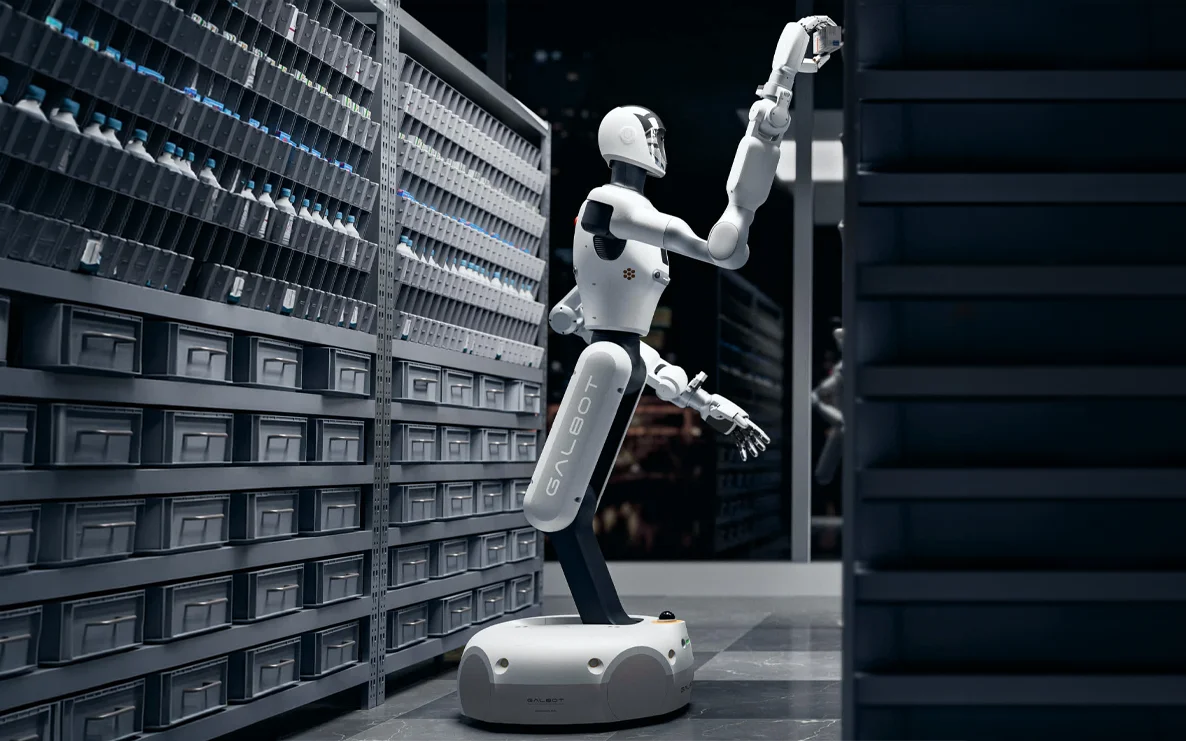
The current Galbot S1 and Galbot G1 use wheeled bases.
That is a logical architecture for many structured environments. Factories, warehouses and other commercial sites often contain large areas of flat flooring, where wheels can provide stable and efficient movement without requiring the robot to solve bipedal locomotion simply to move between workstations.
Galbot describes G1 as a general-purpose embodied large-model robot, with a substantial vertical workspace, dual-arm manipulation and applications spanning industrial, retail and healthcare settings.
But Galbot’s wider research suggests the company is thinking beyond any single hardware configuration.
That is where the story becomes especially interesting.
One of the clearest examples is LDA-1B, a robot foundation model developed by a research team containing numerous Galbot-affiliated researchers.
Rather than learning only from carefully curated demonstrations from one robot, LDA-1B is trained on more than 30,000 hours of heterogeneous embodied data, including human and robot trajectories across real and simulated environments. The researchers explicitly designed its action representation to support learning across different embodiments and manipulation platforms.
The physical experiments make that idea tangible.
LDA-1B was evaluated on both Galbot G1 and Unitree G1, using different hands and robot morphologies. The paper describes the multi-platform setup as demonstrating generalisation across diverse robot forms and end effectors.
There is an especially notable result involving Galbot G1.
The robot was deliberately excluded from the model’s pre-training dataset. After adapting LDA-1B to the previously unseen embodiment, the researchers reported 80–90% success on simpler pick-and-place tasks, with the model also evaluated across contact-rich, dexterous and longer-horizon manipulation.
The significance is not simply the percentage.
It is the direction of travel.
Knowledge learned from a much broader pool of embodied experience can be adapted to a robot that was not part of the original training set.
That is a powerful concept for general-purpose robotics.
Another strand of Galbot-affiliated research extends that thinking into legged humanoid movement.
Humanoid-GPT, developed by researchers affiliated with Galbot, Tsinghua University and other institutions, applies a GPT-style Transformer architecture to whole-body humanoid control. It was trained on a corpus of around 2 billion motion frames, more than 200 times larger than the prior tracker datasets used for comparison in the paper.
The system was deployed on a physical Unitree G1, where the researchers demonstrated zero-shot tracking of previously unseen full-body movements without task-specific fine-tuning.
Humanoid-GPT is not the same model as Galbot’s commercial manipulation stack, and it should not be interpreted as one universal controller already operating across every Galbot robot.
But it is an important signal.
Galbot-linked research is not confined to wheeled manipulation. It now reaches into the scaling of whole-body intelligence for legged humanoids as well.
Taken alongside LDA-1B, the broader direction becomes clearer.
Different jobs will continue to favour different robot bodies.
A wheeled platform may be the most efficient answer for repetitive movement and manipulation across flat industrial floors.
A legged humanoid may become more appropriate where stairs, obstacles and human-designed access routes are fundamental to the task.
Other environments may favour quadrupeds or specialist mobile platforms.
The commercially interesting possibility is therefore not that one body eventually replaces all the others.
It is that the intelligence becomes increasingly reusable while the body is selected around the work.
That could have significant implications for deployment.
If learning can transfer more effectively between embodiments, manufacturers may be able to:
That is much closer to how businesses need robotics to evolve.
The objective is not to find one universally perfect humanoid body.
It is to deploy the right physical platform for the task while continually improving the intelligence underneath it.
This is what makes Galbot particularly compelling.
The S1 and G1 provide practical hardware platforms today.
Behind them sits increasingly ambitious work in large-scale embodied data, manipulation, generalisation and whole-body humanoid control. Galbot itself describes the company as focused on embodied multimodal large-model general-purpose robotics across commercial, industrial and healthcare applications.
The bigger Galbot proposition is therefore not simply wheeled humanoids.
It is embodied intelligence being built to adapt.
That is an important distinction.
As the robotics market develops, the question may become less about whether wheels or legs ultimately win and more about whether the same underlying intelligence can be transferred efficiently into the robot form best suited to the job.
Galbot’s recent work provides an increasingly credible example of that direction.
For UK organisations, that opportunity is also becoming more accessible. Galbot S1 and G1 are now available through The Robot Group, with TRG supporting use-case assessment, platform selection, quotation and structured pilot discussions.
Explore the Galbot range, including the S1 and G1, or follow the wider commercial developments shaping the sector through The Humanoid Market Brief.