Galbot
Galbot S1
Galbot

Galbot S1

Heavy-duty wheeled humanoid for industrial material handling, production support and internal logistics.
Key industrial use cases
Heavy material handling; line-side material transfer; machine loading and unloading; parts and container movement; production logistics; repetitive handling workflows
Request Assessment
Galbot S1

Robot overview

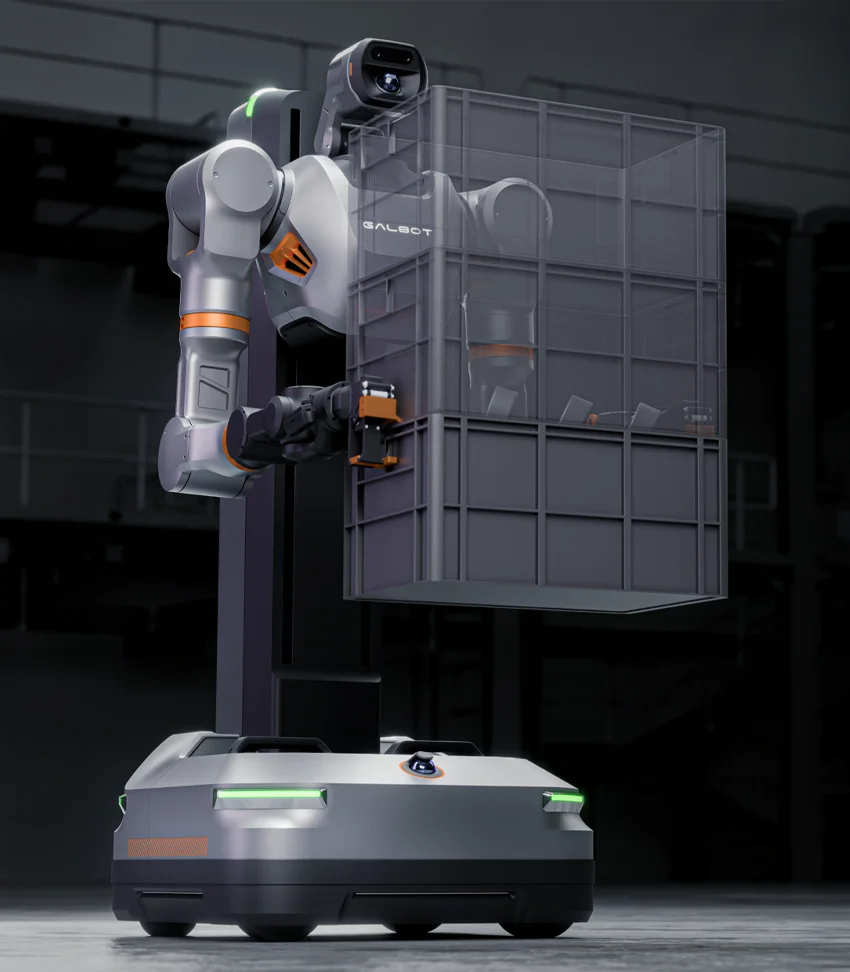
The Galbot S1 is a heavy-duty wheeled humanoid designed to bring embodied AI and mobile manipulation into demanding manufacturing and logistics environments.

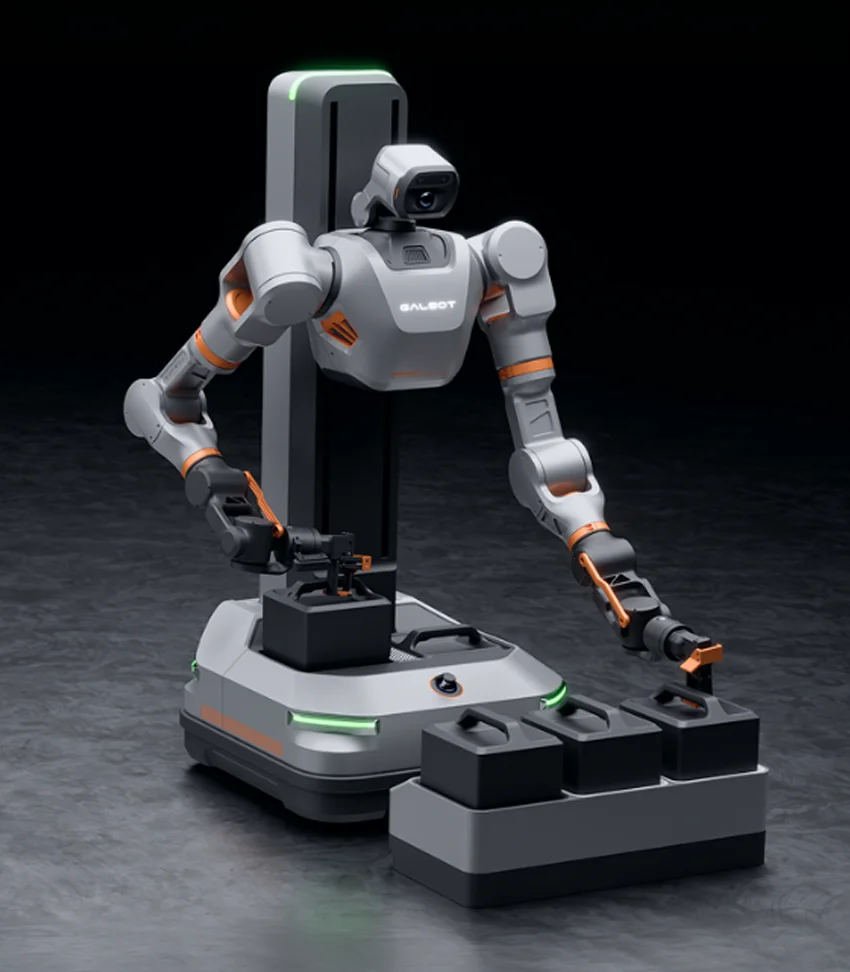
Rather than replicating human walking, S1 combines a stable mobile base with a vertically adjustable torso and two long-reach robotic arms. This architecture is intended to prioritise useful payload, working reach and sustained operation across structured industrial environments.

Galbot positions S1 around heavy-load handling, with a working envelope extending from floor level to approximately 2.3 metres and an operating time of up to eight hours per charge. Autonomous hot-swapping of its batteries is designed to support continuous multi-shift operation without taking the robot out of service for conventional charging.

Its perception and control architecture combines RGB and depth cameras, 3D radar, force sensing and onboard NVIDIA AGX Orin computing. Galbot also emphasises autonomous operation and the ability to respond to disturbances and changes within the working environment rather than relying entirely on fixed, pre-programmed movements.

For UK industrial buyers, the strongest case for S1 is therefore not humanoid appearance in itself. It is the potential to automate physical workflows that require mobility, reach, two-arm manipulation and meaningful load handling within facilities originally designed around people and conventional material flows.

TRG helps businesses assess the specific task, payload, cycle time, operating environment and integration requirements before progressing to demonstration, pilot or deployment.
Galbot S1
Key
Technical Breakthroughs

Heavy-duty dual-arm manipulation


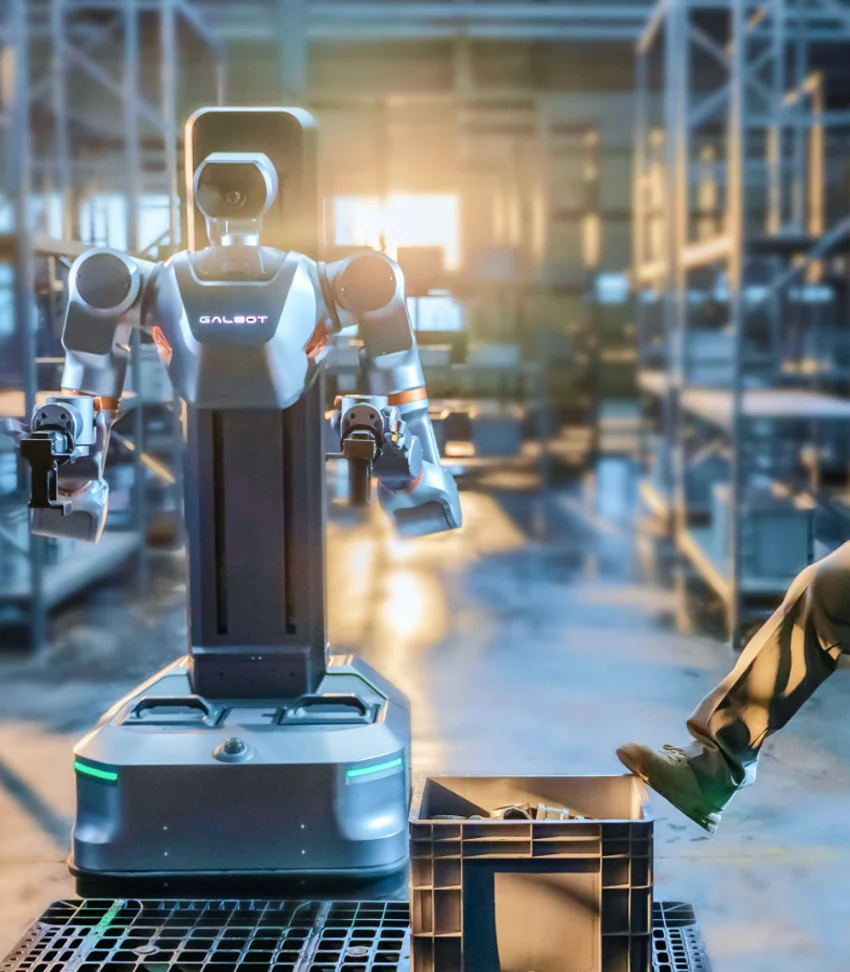
S1 has been developed specifically for heavier industrial handling rather than lightweight demonstration tasks.

Galbot promotes the platform around payload capability of up to 50 kg, aimed at material-handling requirements within manufacturing and logistics environments. The applicable payload will depend on configuration, load geometry, reach, end effector and operating conditions and should be confirmed for each application with Galbot.

Galbot's current published specification table lists 15 kg per arm and 30 kg total while its S1 product headline states up to 50 kg, so TRG will confirm the relevant configuration and rated payload before deployment.

Floor-to-high-level working range


S1 is designed to interact with material across a broad vertical workspace rather than operating at one fixed handling height.

Galbot specifies working coverage from approximately 0 to 2.3 metres, allowing the platform to address tasks involving low-level containers, production equipment, workstations, racks and higher material-transfer points from the same mobile platform.

This could make S1 particularly relevant where one workflow requires the robot to move between multiple pickup and placement heights.

Embodied AI and environmental perception


S1 combines onboard perception with Galbot's embodied-AI architecture to interpret and respond to its surroundings.

Its published sensor configuration includes RGB cameras, depth cameras, multiple 3D radar units and six-degree-of-freedom force sensing on the arms, supported by an NVIDIA AGX Orin 64 GB computing platform.

For industrial deployment, the important question is how reliably this perception translates into repeatable task completion when object positions, people and operating conditions change.

Long-duration autonomous operation


Galbot lists up to eight hours of operation per charge for S1.

More significantly for multi-shift facilities, the robot supports hot-swappable batteries and Galbot promotes autonomous battery exchange as a route to continuous operation without conventional charging downtime.

Actual fleet utilisation will depend on task intensity, payload, travel distance, battery strategy and the operational availability of the battery-swap infrastructure.

Mobile manipulation at industrial scale


S1 combines movement around the facility with two-arm manipulation rather than separating transport and handling into different fixed automation systems.

Its mobile architecture has a manufacturer-listed maximum speed of 1.5 m/s, while its approximately 920 mm arms and 750 mm vertical lift are intended to create a large manipulation envelope around the robot.

The potential advantage is the ability to move between workstations and perform physical handling at each location, particularly where installing fixed automation at every point would be impractical.

Galbot S1
Deployment
+ Scalability

S1 should be deployed around a clearly defined industrial workflow, not a broad expectation that one humanoid will immediately automate every manual task within a facility.

The Galbot S1 has a demonstrable record of operating within CATL production environments on heavy-load production-line tasks, providing an important industrial deployment reference for the platform.

For a UK evaluation, TRG would typically assess:

  • The exact material-handling task and required cycle time
  • Load weight, dimensions, centre of gravity and variability
  • Pickup and placement locations
  • Required working heights and arm reach
  • End-effector or gripper requirements
  • Travel routes, floor conditions and congestion
  • Interaction with machines, racks, conveyors, carts or production equipment
  • Required autonomy and acceptable human-intervention levels
  • Shift pattern, operating time and battery-exchange strategy
  • Human interaction and site-safety controls
  • Network, cybersecurity and data requirements
  • Manufacturer documentation, training and technical support
  • Maintenance, consumables, spare parts and service response
  • Defined task-success, uptime and intervention thresholds for acceptance

The objective is to establish whether S1 provides a genuine operational advantage over fixed automation, AMRs, cobots or alternative humanoid platforms before scaling beyond the initial workflow.

Where the use case is suitable, its combination of mobile manipulation, significant working reach and automated battery exchange creates a potential route from a single-task pilot to multi-workstation or multi-robot deployment.

A structured humanoid robot readiness assessment should come before pilot or purchase. TRG can help define the use case, validate platform fit and coordinate the commercial and deployment route directly with Galbot.

Direct access to leading humanoid OEMs; at the industry’s best rates.
The Robot Group is an independent adviser. Brand names and products are referenced for comparison.

All trademarks are the property of their respective owners. Availability and UK compliance subject to OEM confirmation.
Humanoid performing parts kitting tasks
Ready to deploy humanoid robots in your business?