Humanoid Robots and the Moon: What Lunar Robotics Teaches Industry
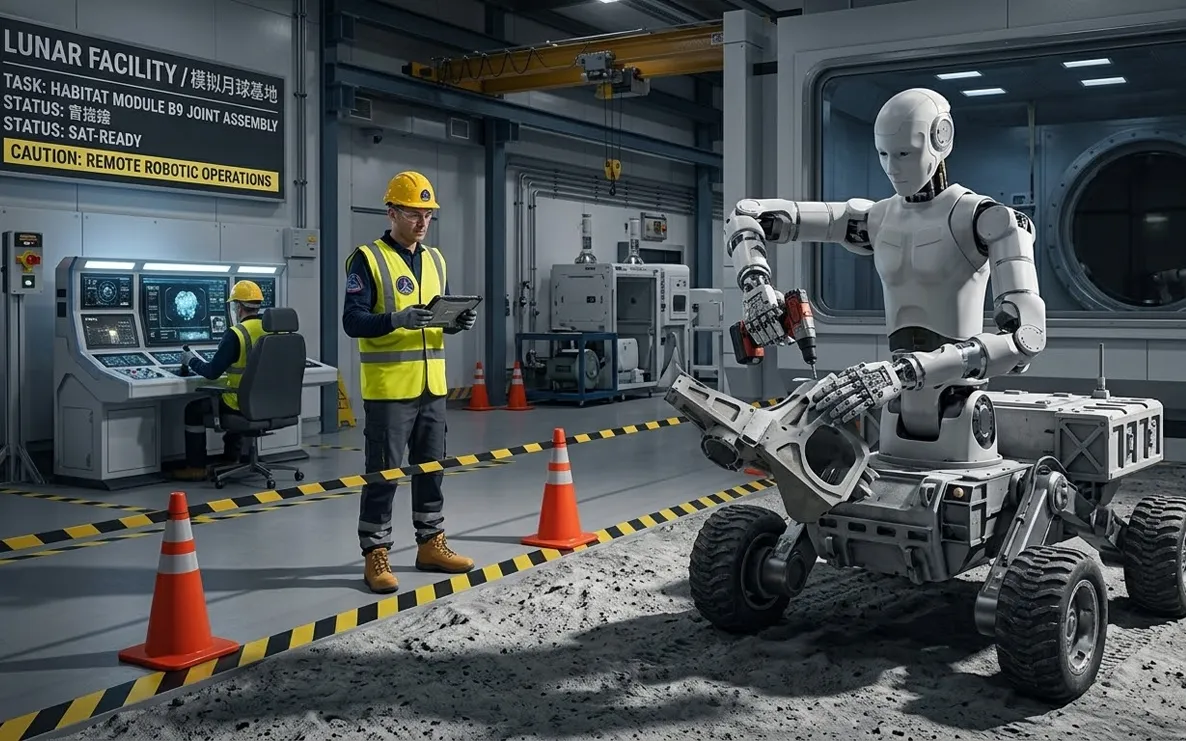


A quiet but meaningful shift is happening in “Moon robotics”: mission planners are starting to treat humanlike dexterity (hands/arms) as a core capability for building and maintaining lunar infrastructure - but they’re pairing it with wheels and teleoperation, not Hollywood-style biped walking.
For UK businesses watching humanoids for factories and warehouses, that matters because the Moon is an extreme testbed for the exact capabilities that will decide whether humanoids become deployable industrial tools: reliability, remote operations, serviceability, and safe task execution.
This week, reporting highlighted Chinese researchers proposing a semi-humanoid robot mounted on a wheeled platform as part of infrastructure for China’s planned lunar research station (often discussed in the context of an International Lunar Research Station timeline to 2035). The concept blends a wheeled base (speed/stability) with an upper body designed for delicate operations like construction, maintenance, sampling and analysis. The details being discussed publicly are telling: waist rotation at 180° each way, forward bend, and a hand with multiple degrees of freedom - i.e., prioritising practical manipulation over biped locomotion.
Why it’s a real signal: it frames “humanoid” as tool-using upper-body dexterity sitting on a mobility platform that’s stable and power-efficient - a design philosophy that maps closely to what many industrial sites will prefer early on.
In late 2025, ESA described a new teleoperation setup linking ECSAT (UK) and ESTEC (Netherlands) over a OneWeb satellite connection, enabling operators in the UK to control a rover arm and do tasks like picking up and relocating rock samples.
Why UK businesses should care: teleoperation isn’t a niche “space trick.” It’s a blueprint for how early humanoid deployments can work in hazardous or uncertain environments: limited autonomy + remote human supervision, with strong comms and haptic/visual interfaces.
Space industry coverage points to a growing set of commercial lunar landings planned for 2026, with multiple providers and payloads aimed at building a sustained cadence of robotic operations on and around the Moon.
Meanwhile, Artemis schedule reshaping continues to emphasise the scale and complexity of the broader lunar push.
The implication: the Moon is shifting from one-off flagship missions to a more continuous operational environment - exactly the kind of situation where dexterous, serviceable robots start to make economic sense.
What space programmes are converging on is a stack that looks a lot like what UK factories and warehouses will demand:
The China example is a great reminder: the early value is often hands + reach + tool use, while locomotion can be solved with wheels or hybrid mobility.
For UK sites, this supports a pragmatic approach: start with mobile manipulation for well-defined tasks (totes/kitting/line-side supply/routine operations) instead of chasing general-purpose “do anything” demos.
Space is normalising the idea that robots should be operated, diagnosed, and updated remotely, because you can’t send a technician easily. ESA’s UK-linked teleoperation work is part of that pattern.
In industry, this translates into: strong uptime logging, clear escalation paths, and “human-in-the-loop” fallback when autonomy hits edge cases.
Lunar robots have to survive dust, temperature swings, and long intervals between interventions. That pushes designs toward:
Those are the same practical questions UK buyers should ask humanoid vendors today: spares, MTTR, swap units, update policy, and how failures are handled.
If humanoids are on your 2026–27 roadmap and you're unsure what your business should do now, speak to our Humanoid Robot experts today and we'll guide you through the latest technology and recommended business implementation steps.