What Happens During a Humanoid Robot Readiness Assessment?
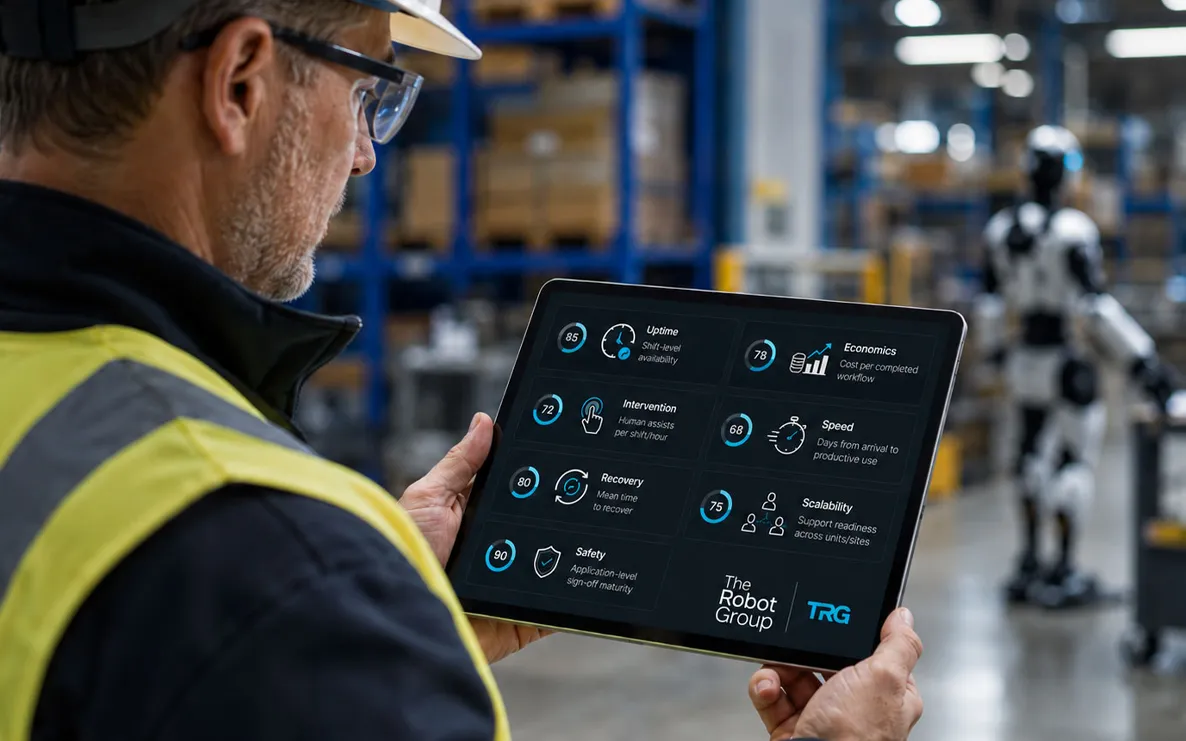


Humanoid robots are attracting serious attention from manufacturers, warehouses, logistics operators and industrial businesses. But before asking which robot to buy, lease or pilot, there is a more important question:
Is your business actually ready to deploy one?
A humanoid robot readiness assessment helps answer that question. It gives operators a structured way to assess task fit, site readiness, safety requirements, support needs and commercial route before committing budget to a pilot, lease or purchase.
For most businesses, the value is not simply in producing a yes-or-no answer. The value is in creating a clearer route from early interest to a practical deployment plan.
Many businesses start by comparing robot brands. That is understandable, but it can lead to the wrong conversation too early.
A humanoid robot may look impressive in a demo, but business deployment depends on a different set of questions:
Can it complete a useful task in your environment?
Can it operate with acceptable levels of human support?
Can the site team manage the process around it?
Is the task economically sensible compared with other automation options?
Can the manufacturer support the robot properly after deployment?
A readiness assessment brings those questions forward before a business narrows down a manufacturer shortlist.
The aim is not to force a humanoid robot into the operation. The aim is to identify whether there is a credible first use case, what would need to be in place, and whether a pilot is worth progressing.
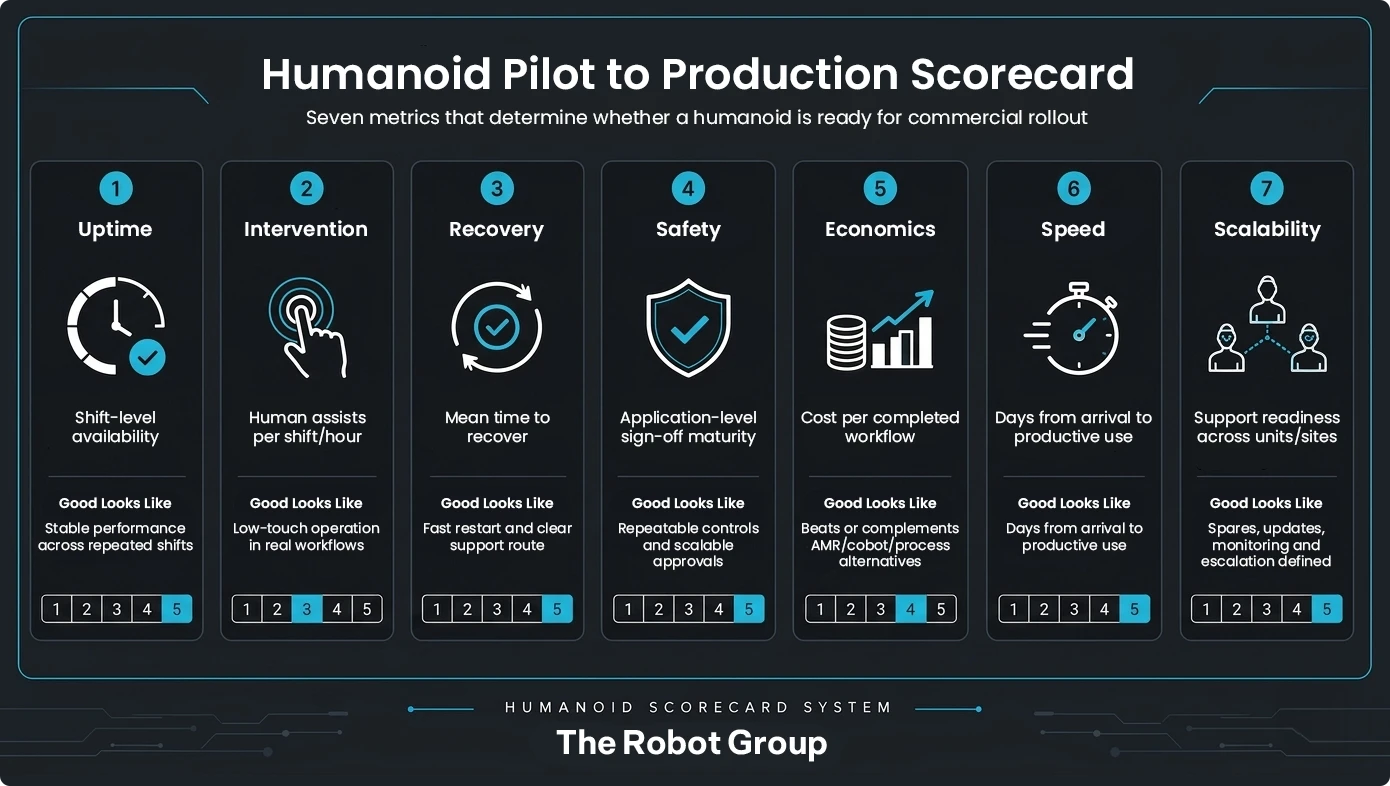
A good humanoid robot readiness assessment should cover more than the robot itself. It should look at the task, the site, the people, the support model and the commercial case.
At TRG, the assessment is built around a 7-metric humanoid scorecard:
This gives the business a practical framework for deciding whether humanoids are worth taking to the next stage.
Uptime is one of the most important measures for any business deployment.
A robot does not need to be perfect to be useful, but it does need to deliver predictable availability. The assessment looks at how the intended task would be measured across repeated shifts, what level of uptime would be useful, and what would make the pilot credible from an operational perspective.
This helps move the conversation away from one-off demonstrations and towards real working performance.
Humanoid robots may still need human support, especially in early deployments. The key question is how much support is acceptable for the task.
The assessment considers how often people may need to assist, reset, guide, supervise or intervene. A task that needs constant human support may not be ready for a commercial pilot, even if the robot can technically perform parts of it.
This is especially important in warehouses, manufacturing sites and internal logistics environments where labour efficiency, supervision time and workflow disruption all affect the business case.
Recovery is about what happens when the robot stops, makes an error, loses context or needs support.
A useful pilot should not only measure successful task completion. It should also look at how quickly the robot can recover, who is responsible for support, what the escalation route is, and whether the site team understands what to do when issues occur.
This is a practical part of readiness because early deployments need clear support routes before go-live.
Safety should be considered from the beginning, not added at the end.
A readiness assessment helps structure the safety questions around the intended task, operating area, people, nearby equipment, manufacturer guidance, documentation and acceptance checks.
TRG does not replace the responsibilities of the client, manufacturer or competent safety professionals. Instead, the assessment helps coordinate deployment readiness between the client, manufacturer and site team, so the right questions are addressed before a pilot or go-live decision.
For UK workplaces, this is especially important because humanoid robots need to be assessed as part of a real operating environment, not just as standalone technology.
Not every task is a good first use case for a humanoid robot.
The assessment looks at the commercial logic behind the task. That may include labour comparison, cost per workflow, operating hours, supervision requirements, downtime risk, alternative automation options and whether the task is valuable enough to justify a pilot.
This does not mean the first pilot must prove full-scale ROI immediately. But it should have a clear commercial reason for existing.
A good readiness assessment should also be honest enough to identify where an AMR, cobot, fixed automation solution or process change may be a better first option.
A humanoid robot pilot is not only about the robot’s capability. It is also about how quickly the site, manufacturer and support teams can move from delivery to useful activity.
The assessment considers commissioning requirements, site preparation, training needs, integration complexity, acceptance checks and how repeatable the process would be if the business moved from one robot to more.
A pilot that takes too long to prepare, support or stabilise may still be valuable, but the business should understand that before committing.
A successful pilot should create learning that can support a wider decision.
Scalability looks at whether the deployment could work beyond a single robot, shift or site. That includes spares, updates, monitoring, support escalation, manufacturer capability, documentation, commercial structure and the practical route to wider rollout.
This is where readiness connects to the longer-term route: pilot, lease, purchase, refresh and future fleet planning.
A useful readiness assessment should leave the business with clearer answers, not just more options.
The output may include a readiness score, use-case shortlist, site observations, key risks, manufacturer considerations, pilot recommendations and potential commercial routes.
Most importantly, it should help the business decide what to do next:
That last outcome is important. A good assessment should be honest enough to say when a humanoid robot is not the right next step.
Humanoid robots are moving quickly, but successful adoption will depend on more than choosing the most visible manufacturer.
For UK businesses, the better starting point is readiness: the task, the site, the safety route, the support model and the commercial case.
That is what a humanoid robot readiness assessment is designed to clarify.
If you are exploring humanoid robots for your business, TRG can help assess use-case fit, site readiness, manufacturer options and the practical route from first pilot to wider deployment.