Unitree UnifoLM-OminiA-0.3: Why the AI Stack Matters
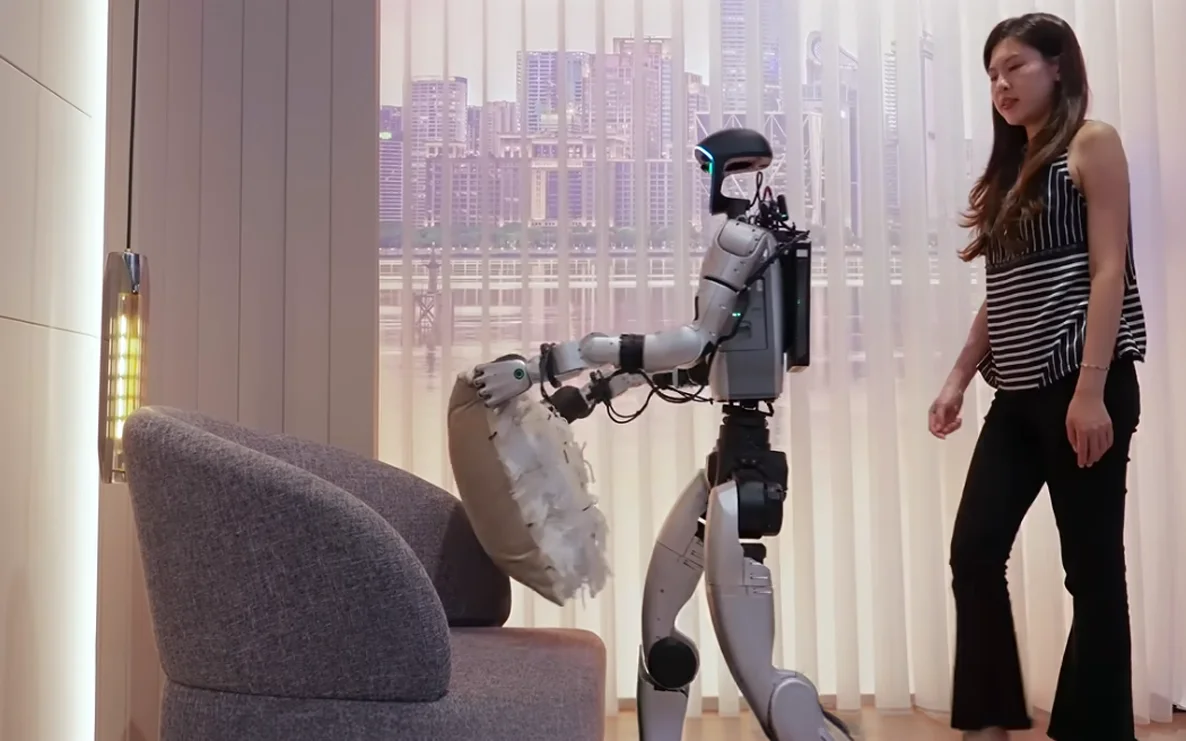


Unitree Robotics has demonstrated UnifoLM-OminiA-0.3, a unified model designed to enable its G1 humanoid robot to understand instructions, interpret its surroundings and perform a range of mobile manipulation tasks.
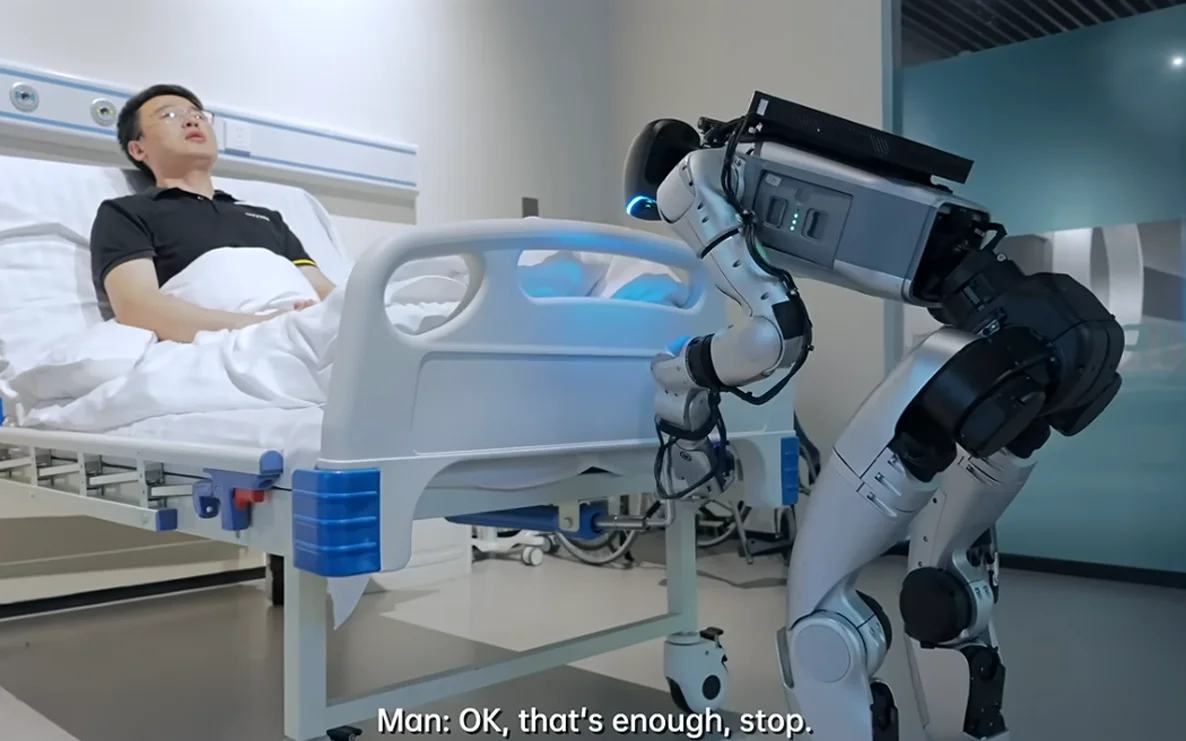
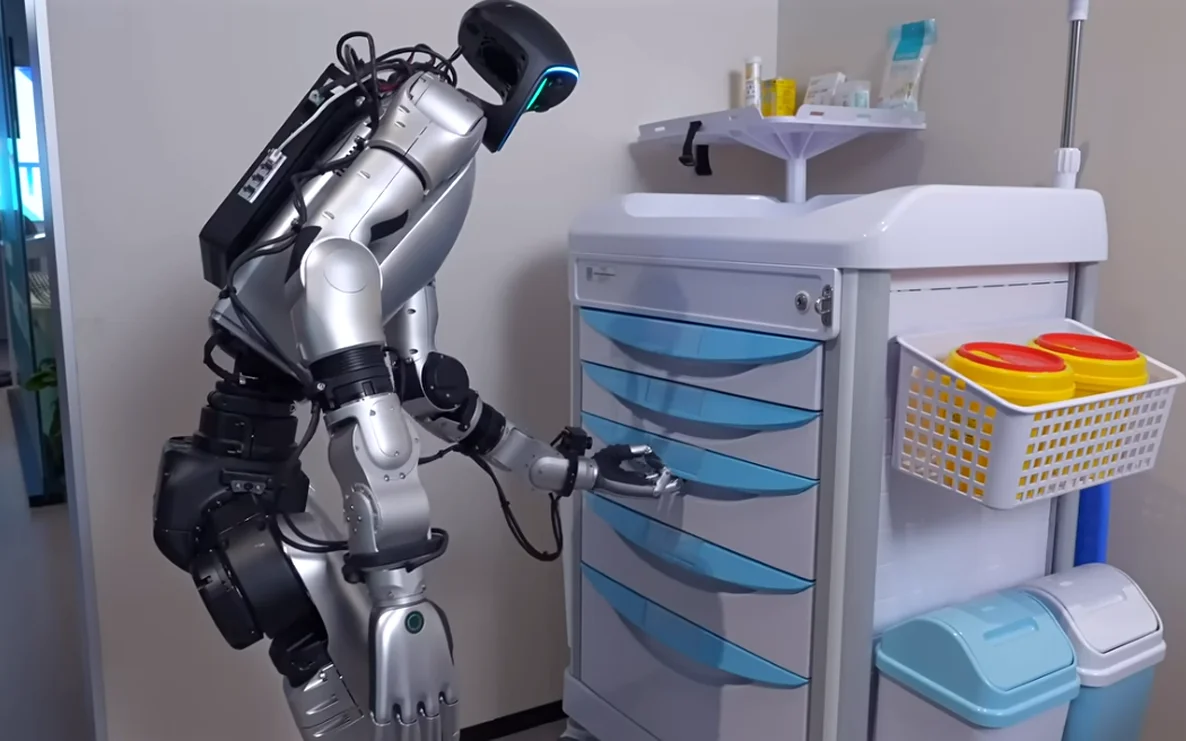
Most coverage has focused on what the robot does in the demonstration: organising household objects, handling clothing, selecting requested items, loading a dishwasher and interacting with an adjustable bed.
For business buyers, however, the more important development is not any individual task.
It is the suggestion that humanoid robot capability is beginning to move away from collections of separately programmed behaviours and towards a more unified intelligence layer connecting language, perception, movement and manipulation.
This could materially change how businesses compare humanoid robots.
The buying decision will no longer be based only on the robot’s height, payload, runtime, hands or purchase price. Organisations may increasingly need to evaluate the complete platform behind the machine: its AI models, training data, compute, deployment tools, cybersecurity, update policy and long-term support.
That is the bigger signal from Unitree’s latest demonstration.
Unitree describes UnifoLM-OminiA-0.3 as a single model capable of handling diverse home-care and wellness tasks through “omni-modal interactive understanding” and whole-body mobile manipulation.
The company says the system is designed to operate autonomously, maintain stable movement and continue or adapt when unexpected disturbances occur during task execution. The demonstration is performed using the compact Unitree G1 humanoid robot.
Tasks shown or reported around the demonstration include:
These are controlled demonstration tasks rather than evidence of a robot operating independently over extended periods in a customer environment. Nevertheless, the combination of voice interaction, perception, navigation, manipulation and whole-body coordination within one demonstration is commercially significant.
Industrial robots have traditionally been engineered around tightly defined movements and predictable environments.
A conventional robot cell might repeat one operation thousands of times with high speed and precision. That model remains extremely valuable, but it depends on controlling the process around the robot.
Humanoid robots are pursuing a different proposition.
Their potential value lies in operating within environments already designed around people: rooms, aisles, shelves, benches, doors, tools, containers and equipment that cannot always be economically redesigned around fixed automation.
To make that possible, the robot must do more than repeat a predefined motion.
It needs to understand an instruction, identify relevant objects, determine where they are, move through the environment, coordinate its body, manipulate the object and react when conditions change.
Unitree’s OminiA-0.3 demonstration is therefore best understood as part of a wider attempt to connect these capabilities through one intelligence system rather than treating each task as an isolated robotics programme.
The direction is important even if the current evidence remains preliminary.
Unitree is widely known for the physical capabilities and comparatively accessible pricing of its humanoid and quadruped robots.
The company’s wider strategy, however, increasingly appears to involve an embodied-AI ecosystem around that hardware.
Its existing UnifoLM work includes UnifoLM-WMA-0, an open-source world-model–action framework intended to model physical interactions and support both simulation and robot-policy development. Unitree has also released UnifoLM-VLA-0, a vision-language-action model designed for general-purpose humanoid manipulation.
Unitree says UnifoLM-VLA-0 has been validated across 12 categories of complex manipulation tasks using a single policy. Its official open-source resources also include manipulation datasets, imitation-learning frameworks, simulation environments and deployment tools for platforms including G1, H1 and the Z1 robotic arm.
OminiA-0.3 therefore should not be viewed as an isolated household demonstration.
It appears to sit within a broader effort to build:
This matters because the strongest humanoid companies may ultimately be those that can improve the entire platform rather than simply manufacture an impressive robot body.
We examined this wider shift in NVIDIA, Unitree and BYD: What This Week’s Humanoid Robot News Really Means for UK Businesses. The market is increasingly becoming a competition between complete ecosystems covering hardware, compute, models, data, development tools and commercial deployment.
Businesses have historically compared automation equipment through relatively visible criteria: reach, payload, speed, accuracy, footprint, energy use, integration cost and expected service life.
Those measures remain important.
But as intelligence becomes embedded more deeply into the robot platform, some of the most commercially important differences may become less visible.
Two humanoid robots with broadly similar physical specifications could perform very differently depending on their underlying models, training data, onboard compute, developer access and ability to recover when something unexpected happens.
The buyer therefore needs to evaluate several connected layers.
This includes the robot’s size, weight, reach, payload, degrees of freedom, hand configuration, runtime, mobility and sensing equipment.
The physical platform determines whether the robot can reach the required objects, navigate the operating area and safely perform the intended movement.
But hardware specifications alone do not establish whether it can complete a business task reliably.
The model determines how the robot interprets instructions, recognises its surroundings, selects actions and responds to changing conditions.
Important questions include whether the model can generalise beyond the original training scenario and whether a new task requires extensive programming, additional training or human teleoperation.
Robot capability depends heavily on the data used to train and improve it.
Buyers should understand what data the robot collects, where it is processed, whether it leaves the customer’s site, how long it is retained and whether operational data may be used to improve models serving other customers.
Data ownership may become as important to humanoid procurement as mechanical service terms.
A capable foundation model does not automatically create a production-ready system.
Businesses may still require task configuration, environment mapping, integrations, fleet monitoring, user permissions, remote support, safety controls and defined recovery procedures.
The quality of the deployment tools will influence how quickly a demonstration can become a repeatable operational process.
The final layer covers documentation, software updates, spare parts, maintenance, cybersecurity, operator training and technical accountability.
When a model update changes robot behaviour, buyers need to know how that update is tested, approved, installed and, where necessary, reversed.
This is why humanoids increasingly need to be assessed as supported technology platforms rather than standalone capital equipment.
This framework is relevant not only to Unitree, but to every organisation comparing humanoid platforms.
TRG’s humanoid robot readiness assessment examines the use case and operating environment before a business commits to a particular manufacturer, pilot, lease or purchase route.
The OminiA-0.3 demonstration is a strong technical signal. It shows Unitree bringing instruction understanding, visual perception, navigation and whole-body manipulation together within a single humanoid-AI system.
The next important step will be understanding how this capability becomes available to developers and commercial users, and how consistently it can perform outside a controlled demonstration environment.
At the time of writing, Unitree’s official open-source resources include models and frameworks such as UnifoLM-VLA-0 and UnifoLM-WMA-0. A dedicated OminiA-0.3 technical paper, public model card or downloadable release does not yet appear to have been published.
That is not unusual for an early-stage technology announcement. However, further technical and commercial information will help businesses assess where OminiA-0.3 could fit within future evaluation and deployment programmes.
Important areas to understand include:
These are not criticisms of the technology. They are the natural next questions as an impressive research and development capability moves towards wider customer evaluation.
Businesses considering Unitree hardware can review the broader Unitree robot range available through TRG, including G1, H1, H2 and R1.
The tasks shown are domestic and wellness-oriented, while TRG’s primary audience includes manufacturing, warehousing, logistics and other business environments.
That does not make the development irrelevant.
Many of the underlying technical problems are transferable.
Retrieving a requested medicine box requires object recognition, instruction understanding, navigation and manipulation. Those same capabilities could eventually support component retrieval, mixed-SKU picking or kitting.
Organising clothing involves handling deformable objects, a difficult manipulation problem that also appears in textiles, packaging and fulfilment.
Interacting with a bed or other piece of equipment requires the robot to locate and operate an interface designed for people. Similar challenges exist around carts, drawers, cabinets, doors, fixtures and existing machinery.
The important question is not whether the exact household task will appear in a factory.
It is whether the underlying capability can transfer reliably into a defined industrial workflow with measurable performance, appropriate controls and a viable support model.
This is also why businesses should compare humanoids with other forms of automation before assuming a humanoid is the answer. Our guide to humanoid robots vs AMRs and cobots explains where each approach is likely to be strongest.
Businesses should not purchase a humanoid robot solely because a new model appears capable in a demonstration.
They should begin with the task.
A credible evaluation should identify:
Only then should the business compare robot bodies and AI platforms.
For organisations at the beginning of that process, Humanoid Robots for Business: Your First 20 Questions Answered provides a practical introduction to use cases, costs, leasing, purchasing and deployment readiness.
Unitree has already helped make humanoid hardware more accessible to universities, laboratories, developers and commercial innovation teams.
Its next challenge is to show that its software and intelligence platforms can move with similar speed from demonstrations into supported, repeatable customer use.
OminiA-0.3 suggests that Unitree wants to compete not only as a robot manufacturer, but as a provider of the intelligence layer controlling those robots.
That could make the company’s platforms more attractive, but it also makes due diligence more important.
The deeper the model is integrated into the robot’s operation, the more buyers need visibility into data use, software dependencies, update control, cybersecurity, licensing, support and long-term platform compatibility.
This issue is particularly relevant as Chinese humanoid manufacturers accelerate investment in both hardware and embodied AI. Our analysis of five Chinese humanoid robot companies driving China’s robot race examines the wider industrial and commercial context.
UnifoLM-OminiA-0.3 is worth watching because it points towards a more integrated form of humanoid intelligence.
Its importance is not that a G1 can move a cushion or load a dish. The importance is the attempt to connect instruction understanding, perception, mobility and manipulation through one model.
That is the direction the wider humanoid market is moving.
But buyers should maintain a clear distinction between model capability, demonstration capability and commercially supported deployment capability.
A strong video may justify further investigation. It does not replace repeatability data, site testing, documentation, technical support or a structured acceptance process.
The organisations that adopt humanoids successfully will not simply choose the robot with the most impressive movements.
They will assess the entire platform around it—and determine whether that platform can create reliable, supportable and economically meaningful performance inside their operation.
The Robot Group can provide access to an official Unitree dealer route for UK organisations exploring humanoid robotics, embodied-AI development, education, research and controlled business evaluation.
TRG can help you compare Unitree platforms, assess the intended task, identify the appropriate configuration and structure a route into evaluation, pilot or purchase.
Explore Unitree robots or book a humanoid robot readiness assessment.
For ongoing analysis of humanoid manufacturers, AI platforms, deployment evidence and commercial developments, explore The Humanoid Market Brief