NVIDIA, Unitree and BYD: What This Week’s Humanoid Robot News Really Means for UK Businesses


BYD’s humanoid robot story is the headline that will get attention. NVIDIA’s Unitree move may be the story that matters more.
In the space of a few days, the humanoid robotics market has produced the kind of news cycle that makes the sector feel as if it has suddenly accelerated. BYD, one of the world’s most important electric vehicle manufacturers, has confirmed it is developing humanoid robots and may eventually use its dealer network as a route to market. NVIDIA has announced an open humanoid robot reference design built around Unitree hardware, tactile hands, Jetson Thor compute and Isaac GR00T software. Amazon has also used its Dartford fulfilment centre in the UK to show what real warehouse robotics adoption looks like when it is tied to defined tasks, operational workflows and phased deployment.
For UK businesses, the important question is not simply: which company has the most impressive humanoid robot?
The better question is:
Which humanoid robot ecosystems are becoming credible enough to assess, pilot and eventually deploy inside real businesses?
That distinction matters. The humanoid market is moving beyond viral demonstrations and into something more commercially important: a platform race between robot manufacturers, AI infrastructure providers, automotive groups, logistics operators, component suppliers and deployment partners.
For manufacturers, warehouses, 3PLs and industrial operators, this is the moment to pay attention - but not to rush.
The next phase of humanoid robotics will not be won by the best video. It will be won by the companies that can combine hardware, software, safety documentation, support, financeability, service coverage and credible first use cases.
That is where the market is heading.
BYD’s entry into humanoid robotics is a major signal because it shows how closely the automotive and robotics markets are beginning to converge.
According to recent reports, BYD has confirmed that it is developing humanoid robots, with household scenarios and potential use of its auto dealer network both under consideration. The story is naturally attractive because BYD already has strengths that matter in robotics: manufacturing scale, batteries, motors, sensors, vehicle software, supply chain control and a global commercial footprint.
That combination should not be underestimated.
Humanoid robots are not only an AI challenge. They are also a manufacturing challenge. They require reliable actuators, battery systems, sensor integration, embedded computing, mechanical design, safety engineering, supply chain discipline and the ability to build complex products repeatedly at cost.
Those are areas where large automotive manufacturers may have an advantage over smaller robotics companies.
However, for UK industrial buyers, the BYD story also raises a more practical question: is this a business-deployment story, or mainly a future consumer and showroom story?
If the early focus is household scenarios, dealerships or customer-facing environments, the immediate relevance to UK factories and warehouses may be limited. A robot that can act as a sales guide in a showroom is not the same as a robot that can reliably perform tote handling, kitting, line-side replenishment, goods movement or repetitive inspection tasks in an industrial setting.
That does not make BYD irrelevant. It makes the story more nuanced.
The real importance of BYD’s move is that major industrial companies now appear to see humanoid robots as a logical extension of their existing technology base. If cars are becoming intelligent, mobile, sensor-rich machines, then humanoids can be seen as the next form factor for the same underlying capabilities.
For business buyers, the lesson is clear: humanoid robotics is becoming part of the wider industrial technology race, not a standalone novelty market.
The NVIDIA story deserves more attention from business leaders because it points to the deeper structure of the market.
NVIDIA has announced the Isaac GR00T Reference Humanoid Robot, described as an open humanoid robot reference design built on its Jetson Thor compute platform and Isaac GR00T development stack. The design combines a Unitree H2 Plus humanoid robot, Sharpa five-fingered tactile hands, NVIDIA onboard compute and Isaac GR00T software and workflows.
That matters because it shifts the conversation from one robot to a repeatable development platform.
In simple terms, NVIDIA is not just trying to power humanoid robots. It is trying to shape the infrastructure layer behind them.
That infrastructure could include:
This is important because humanoid robots will not scale if every manufacturer has to solve every problem alone. The industry needs common development environments, better simulation tools, faster skill training, improved manipulation capability and a clearer route from lab testing to real-world use.
NVIDIA’s move also shows how the humanoid stack may split into layers.
One company may provide the robot body. Another may provide the hands. Another may provide the compute. Another may provide the software stack. Another may provide deployment support. Another may provide finance or leasing.
That is why the humanoid market is becoming a platform war.
The key question is no longer simply:
Who makes the robot?
It is:
Who controls the ecosystem around the robot?
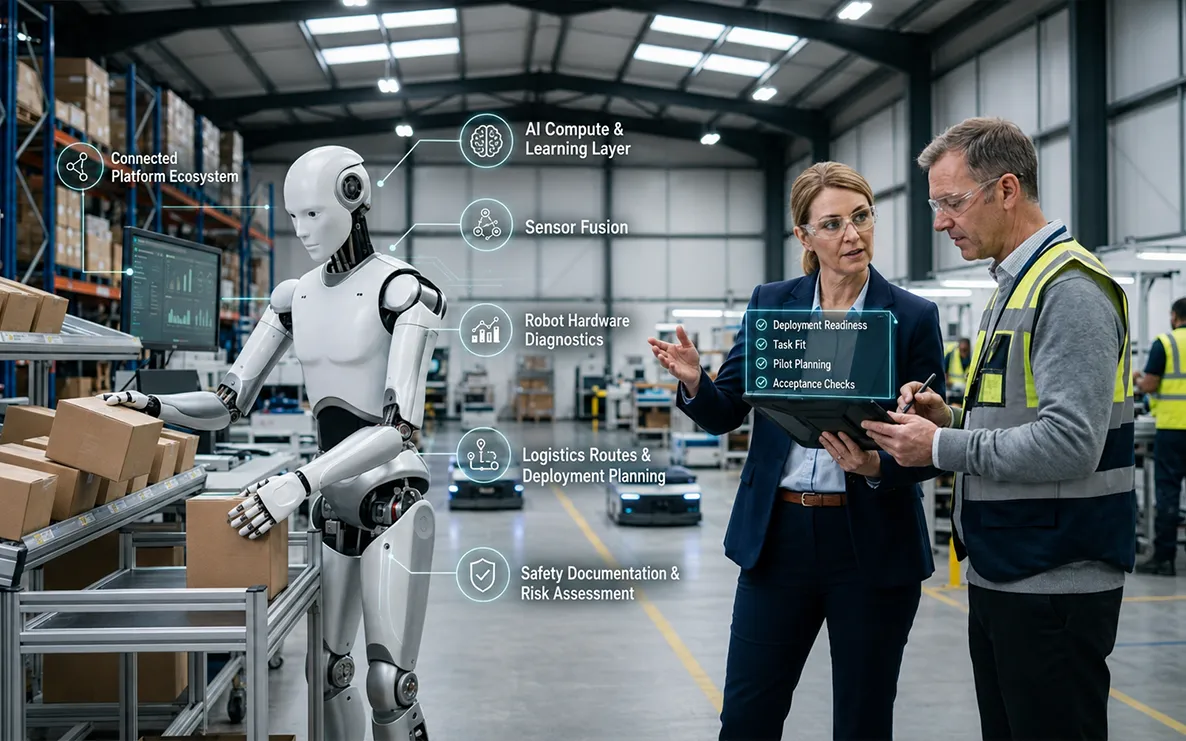
For UK businesses, this is critical. A humanoid robot should not be assessed only on walking speed, payload, appearance or demo performance. It should be assessed on the maturity of the whole commercial and technical package around it.
That includes:
A robot with a strong demo but weak support may be a poor business decision. A less glamorous platform with better documentation, clearer use cases and stronger manufacturer support may be the better pilot candidate.
That is the practical point many headlines miss.
The Unitree element of the NVIDIA announcement is especially significant.
Unitree has become one of the most visible Chinese humanoid and quadruped robotics companies, known for comparatively accessible hardware and fast product development. NVIDIA’s reference design using a Unitree H2 Plus body shows how Chinese robot hardware is increasingly part of global robotics development conversations.
This creates a useful way to understand the market:
China is moving quickly on robot hardware. NVIDIA is building the AI and compute layer. Automotive companies like BYD are bringing manufacturing logic. Warehouse operators like Amazon are showing what practical automation adoption looks like.
But UK businesses still need something else: a use-case-led route to deployment.
That is the missing layer.
A robot platform may be technically impressive, but a business still needs to know whether it is suitable for a specific environment. Can it work near people? Can it operate around racking, cages, pallets, conveyors, forklifts or uneven floor conditions? Can it perform the task at an acceptable speed? What happens when it fails? Who supports it? What documentation is required before go-live? How is success measured?
For early-stage humanoid pilots, these questions matter more than broad claims about general-purpose labour.
The first serious business use cases are likely to be narrow, repetitive and controlled. In warehouses and manufacturing sites, that could include:
The goal is not to replace an entire workforce with general-purpose robots on day one. The goal is to identify where a humanoid form factor can solve a real operational problem better than existing alternatives.
That is a much higher standard than a trade-show demonstration.
While humanoid robots dominate attention, Amazon’s latest warehouse robotics announcement may be one of the most useful reference points for business leaders.
Amazon unveiled an upgraded AI-powered version of its Proteus warehouse robot at its Dartford fulfilment centre as part of a major European fulfilment investment. Reports say the upgraded Proteus can respond to conversational prompts, determine task priorities, plan routes and operate more widely across warehouse floors. Amazon also highlighted other robotic systems, including tote-handling and touch-sensitive robot developments.
This is not a humanoid story in the narrow sense. But it is extremely relevant to humanoid adoption.
Why? Because Amazon shows what credible warehouse automation looks like:
That is the benchmark humanoid robotics will be judged against.
A humanoid robot does not get a free pass because it looks more flexible. It still needs to perform useful work, safely and reliably, inside a business environment.
For UK warehouse operators, Amazon’s announcement is a reminder that automation adoption is not driven by excitement alone. It is driven by operational fit.
That means any humanoid pilot should begin with the task, not the robot.
The right starting question is not:
Which humanoid should we buy?
It is:
Which task, in which environment, with which success criteria, could justify a humanoid pilot?
Only after that should a business compare manufacturers.
Jensen Huang’s comments about humanoid robots and physical AI have helped drive huge attention toward the sector. Recent investor-focused coverage has repeated the idea of humanoid robots as a potential $40 trillion market opportunity.
That kind of number is powerful. It attracts investors, founders, OEMs, suppliers and media attention.
But businesses should treat it as a macro narrative, not a procurement argument.
A large theoretical market does not mean every humanoid robot is ready for deployment. It does not mean every pilot will succeed. It does not mean every manufacturer will survive. It does not remove the need for safety planning, site readiness, support agreements, acceptance testing or commercial discipline.
For UK businesses, the more useful interpretation is this:
The humanoid robot market is attracting serious capital because the long-term labour and automation opportunity is enormous. But near-term adoption will depend on narrow use cases, credible manufacturers and structured pilots.
That is a much better lens than either hype or dismissal.
Humanoid robots are not science fiction. They are also not yet a simple plug-and-play labour replacement.
They sit in the middle: commercially emerging, technically impressive, but still requiring careful assessment.
The latest news points to five important conclusions for UK businesses.
The future of humanoids will not be defined by hardware alone. Buyers will need to assess the whole ecosystem around a robot: AI stack, software tools, manufacturer support, maintenance model, documentation, training, safety guidance and commercial structure.
A humanoid robot is not just a machine. It is a platform decision.
BYD’s move shows that automotive manufacturers may become serious players in humanoid robotics. That matters because carmakers understand scale manufacturing, supplier management, batteries, embedded systems and service networks.
The question is whether those strengths translate into credible business robotics deployments.
Chinese humanoid companies are moving quickly, especially on hardware availability and price. That could create opportunities for experimentation and cost-effective pilots.
But UK buyers should also apply careful diligence around support, cyber, data, documentation, parts, compliance and long-term serviceability.
Fast hardware is not the same as deployment readiness.
NVIDIA’s Isaac GR00T reference design suggests the company wants to play a central role in humanoid development infrastructure. If successful, this could accelerate the sector by giving researchers and developers more standardised tools.
For business buyers, this matters because platforms with stronger developer ecosystems may mature faster.
The most commercially useful humanoid deployments are unlikely to look like viral videos. They are more likely to involve repetitive handling, movement, inspection or support tasks in controlled environments.
That may be less exciting - but it is where real adoption starts.
Before approaching a manufacturer or committing to a pilot, UK businesses should ask a more disciplined set of questions.
What specific task do we want the robot to perform?
Is that task repetitive, measurable and operationally valuable?
Why might a humanoid be better than an AMR, cobot, conveyor, fixed automation system or process redesign?
What does success look like after 30, 60 or 90 days?
Where will the robot operate?
Is the environment controlled enough for an early pilot?
Are there people, vehicles, forklifts, cages, pallets or other moving risks nearby?
What floor conditions, lighting, Wi-Fi, access rules and operating zones need to be considered?
Has the manufacturer shown credible business or industrial deployment evidence?
What support model is available in the UK or Europe?
What documentation, training and maintenance processes are provided?
What are the lead times, service levels and spare parts arrangements?
What safety documentation will be required before go-live?
Who provides robot-specific guidance?
What acceptance checks will be completed?
What happens if the robot fails, stops, falls, loses connectivity or cannot complete the task?
Is the robot available to lease, buy or pilot?
What is included in the monthly or upfront cost?
Are service, maintenance, parts, software and support included?
Is there a route to scale if the pilot succeeds?
Is there a route to exit if the pilot does not meet the acceptance criteria?
These questions are not designed to slow adoption down. They are designed to make adoption more serious.
The humanoid robot market is still early. No single manufacturer has won. No single platform is right for every business. Some robots may be better suited to logistics. Others may be more relevant for manufacturing support, inspection, research, service environments or future customer-facing roles.
That is why a manufacturer-independent approach matters.
The best decision is not necessarily to choose the most famous robot, the cheapest robot, the most human-looking robot or the robot with the best online demo.
The best decision is to choose the robot that fits the task, site, support requirements and commercial model.
That is also why businesses should avoid locking themselves too early into a single manufacturer without first comparing alternatives. A structured process should consider use-case fit, deployment readiness, product maturity, industrial evidence, support model, documentation, safety readiness, financeability and long-term fleet supportability.
For TRG, the core principle is simple:
Manufacturer-independent. Use-case led. Built around fit, not lock-in.
This week’s headlines are not just separate stories. They are signs of a market changing shape.
BYD shows that major automotive manufacturers are moving toward humanoid robotics. NVIDIA shows that the AI and compute layer may become one of the most important battlegrounds. Unitree shows that Chinese hardware platforms are moving quickly. Amazon shows that real automation adoption still depends on defined tasks, controlled environments and operational value.
For UK businesses, the conclusion is not to rush into humanoids because the market is noisy.
The conclusion is to start preparing properly.
That means identifying potential use cases, understanding the manufacturer landscape, assessing site readiness and building a structured route from curiosity to pilot.
The next phase of humanoid robotics will not be about asking whether humanoids are coming. They are.
The more important question is:
Which humanoid robots are commercially credible enough for your business - and what would need to be true before you pilot one?
That is where serious buyers should begin.
The Robot Group helps UK businesses assess humanoid robot opportunities with a practical, manufacturer-independent route from first enquiry to deployment planning.
We support businesses with:
Start with a readiness assessment and understand which humanoid robot options are most relevant to your site, task and commercial requirements.