Humanoid Robots Won’t Replace Work - They’ll Redesign It
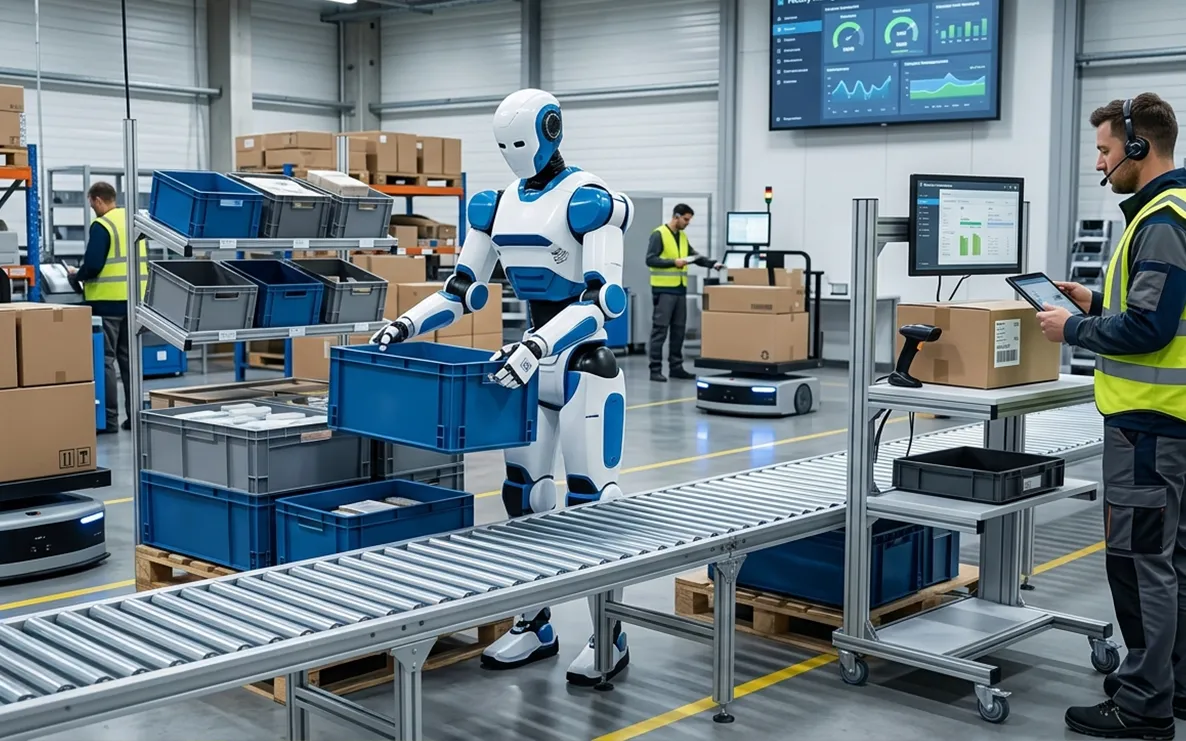


Why the first real impact of humanoids in UK industry will be job redesign, not job loss
The humanoid robot debate is still framed the wrong way. The loudest question is whether robots will replace people. The more useful question for UK businesses is what happens to work when humanoids start showing up on the factory floor, in the warehouse, and across routine internal operations.
The answer is less dramatic, but more important: the first real impact of humanoids will be job redesign. That is already the pattern in broader automation and AI. The International Federation of Robotics says employers are increasingly using robots to tackle labour gaps rather than simply eliminate roles, and ManpowerGroup’s 2026 UK survey says only 10% of employers are using AI and automation to replace headcount.
That matters because UK industry is not entering this shift from a position of labour abundance. The UK Warehousing Association says the sector is facing a skills crisis and notes that warehousing already employs more than 650,000 people, while a recent HEPI piece says more than a third of warehouse employers report skills gaps in automation and robotics. In manufacturing, a January 2026 industry write-up citing MTC research pointed to a 47,000-person skills gap.
So the most likely near-term story is not “humanoids take jobs.” It is “humanoids change jobs.” They will absorb some repetitive physical tasks, but they will also create new supervisory, exception-handling, maintenance and workflow roles around them. That mirrors BCG’s recent argument that AI often reshapes roles more than it removes them, with routine work automated while more complex responsibilities expand.
The easiest way to understand humanoids in business is not as a “replacement technology,” but as a catalyst for four new operating roles.
The first is the task owner: the person responsible for defining what the robot is supposed to do, where it operates, what “good” looks like, and what counts as a failure.
The second is the robot supervisor: the worker or team lead who monitors performance, handles stoppages, and decides when the robot needs intervention or rerouting.
The third is the exception handler: the person who steps in when the environment changes, the robot encounters a non-standard object, the task sequence breaks, or the site needs human judgment.
The fourth is the service co-ordinator: the role that sits between operations and technical support, making sure updates, maintenance, training and fault response happen without disrupting the shift.
Those roles may not all be new job titles on day one. In many businesses they will initially be added into existing operational roles. But over time, they become the real operating model around the robot.
This is not just a future-of-work thought experiment. UK logistics and industrial businesses are already under pressure from labour availability, retention, wage costs and changing skill needs. CBRE recently highlighted labour shortages as a driver of wage pressure in logistics real estate, while Timewise warned that hundreds of thousands of transport workers are due to retire by 2030 and argued that job design itself needs to change.
Humanoids fit directly into that conversation because they are not just another automation asset. Their promise is that they can work in human-designed environments and support human-shaped workflows without requiring a full site redesign. That makes them particularly relevant where businesses want to improve resilience and productivity but cannot easily rebuild the operation around fixed automation.
The opportunity is strongest where the work is physically repetitive, variable enough to defeat simple fixed automation, and important enough that labour churn or fatigue is costly. In those environments, the value of a humanoid is not simply that it “does the task.” It is that it changes who has to do the hardest part of the task, and how often.
The biggest mistake businesses can make is treating humanoids as a straight labour-substitution line item. That creates the wrong expectations internally and leads to the wrong pilot design.
A better framing is this: humanoids are a workforce design tool. They allow businesses to remove low-value repetition from a role while increasing the value of the human part of that role. That only works if the deployment is designed around real workflows, clear exception paths, and training for the people who will work around the robot.
This is where many pilots will succeed or fail. Not on whether the robot can walk, but on whether the organisation can adapt the job around it.
A strong rollout does not start with “where can we cut heads?” It starts with “where are we wasting skilled human time on repetitive physical effort?”
That leads to a better sequence. First, choose one repeatable workflow. Then identify which part is robotic and which part remains human. Then define what the person’s role becomes once the robot takes on the repetitive element. Only after that do you set the performance metrics.
This is also why the skills conversation matters so much. UKWA is explicitly calling for skills reform for warehousing, and government-backed work on AI skills is focused on how technology changes labour demand rather than simply removing it.
The first real humanoid winners in UK industry will not be the businesses that chase the biggest headlines. They will be the businesses that redesign work intelligently.
That means treating humanoids as part of the operating model, not just part of the capex plan. It means planning for supervision, intervention, support and retraining from the start. And it means recognising that the commercial value of a humanoid often comes not from replacing a person, but from allowing that person to do more valuable work.
That is the real shift. Humanoid robots won’t replace work first. They’ll redesign it. And for many UK businesses, that may be the more important opportunity.