Humanoid Robots for Defence: Where the UK Should Start


Humanoid robots are beginning to move from consumer fascination into serious industrial and operational discussion. For UK defence and public-sector teams, the question is no longer simply whether humanoids are interesting. It is where, if anywhere, they could create practical value - and how they should be assessed before any serious procurement conversation begins.
The answer is likely to be less dramatic than many expect.
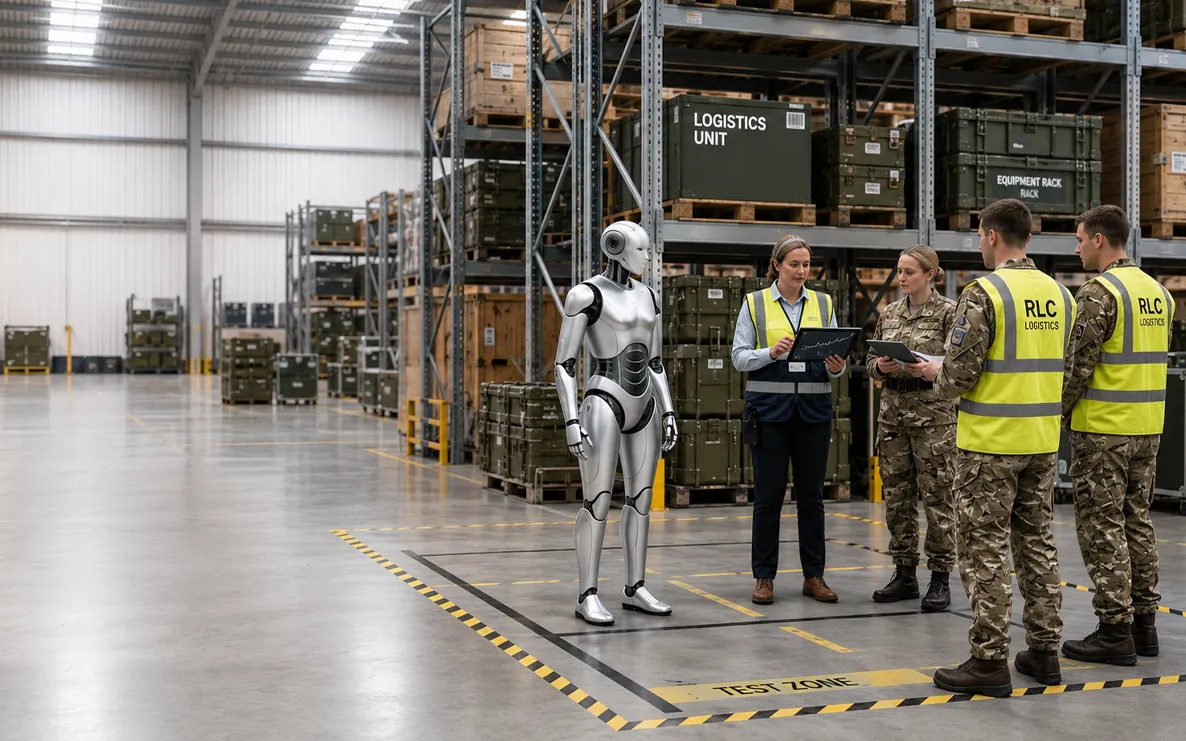
The first meaningful defence use cases for humanoids are unlikely to be front-line combat. They are more likely to sit in support environments: logistics, stores movement, inspection, base operations, hazardous-area assessment, training support and other tasks where human-shaped mobility may help in places already designed around people.
That distinction matters. The UK defence sector already has a clear interest in robotics and autonomous systems. Dstl describes its robotics and autonomous systems work as focused on creating effective and trustworthy uncrewed platforms for UK security and defence, while DASA’s Open Call is designed to support innovative ideas that improve UK defence and security at different maturity levels.
But humanoids are not just another robot category. They combine mobility, manipulation, software, perception, AI, cyber exposure and human interaction in one platform. That makes them potentially useful, but also difficult to assess without a structured process.
The most important early question is not “which humanoid should defence buy?”
It is “which use cases are worth testing, and which platforms are mature enough to test them?”
A humanoid may look impressive in a demonstration and still be unsuitable for a defence or public-sector environment. The real assessment needs to look at task fit, operating conditions, reliability, intervention rate, supportability, cyber posture, data handling, provenance, supply-chain risk and maintainability.
That is especially important in public-sector and defence contexts, where the consequences of poor vendor selection can be higher than in a standard commercial pilot.
The strongest early opportunities are likely to be non-kinetic, support-led and controlled.
That could include repetitive logistics tasks in controlled areas, movement of stores or equipment, inspection support in hazardous or difficult environments, casualty simulation or training support, maintenance assistance, or controlled testing where human-shaped movement provides an advantage over wheels, tracks or fixed automation.
The key word is controlled.
Early humanoid trials should focus on bounded environments, clear tasks, measurable outcomes and defined operator oversight. Defence does not need humanoid hype. It needs evidence.
A serious humanoid evaluation should not start with a product catalogue.
It should start with a structured market and use-case review.
That means identifying potential tasks, assessing which tasks are genuinely suited to humanoid platforms, mapping credible manufacturers, understanding support and documentation maturity, and creating a trial design that produces useful evidence rather than a one-off demonstration.
A strong evaluation should ask:
Those questions matter more than whether the robot looks advanced.
Humanoids may have a place in defence and public-sector operations, but the right starting point is not procurement. It is structured assessment.
The Robot Group can support early-stage conversations by helping public-sector and defence teams map the humanoid market, identify potential use cases, compare manufacturers, and design practical evaluation routes before committing to any specific platform.
That is where the category needs discipline.
The UK should not ask whether humanoid robots are exciting. It should ask where they are useful, which platforms are credible, and what evidence is needed before they move from interest to trial.
That is the right place to start.
The Robot Group provides manufacturer-independent support for organisations exploring humanoid robots, including market mapping, use-case scoping, manufacturer comparison and trial-readiness planning. Speak to our team today if you are assessing where humanoids may fit in a defence, public-sector or operational environment.