

Ready to deploy humanoid robots in your business?
Thank you for reaching out. A member of our team will be in touch shortly.
Oops! Something went wrong while submitting the form. Please try again.


The Robot Group is an independent adviser. Brand names and products are referenced for comparison.
All trademarks are the property of their respective owners. Availability and UK compliance subject to OEM confirmation.
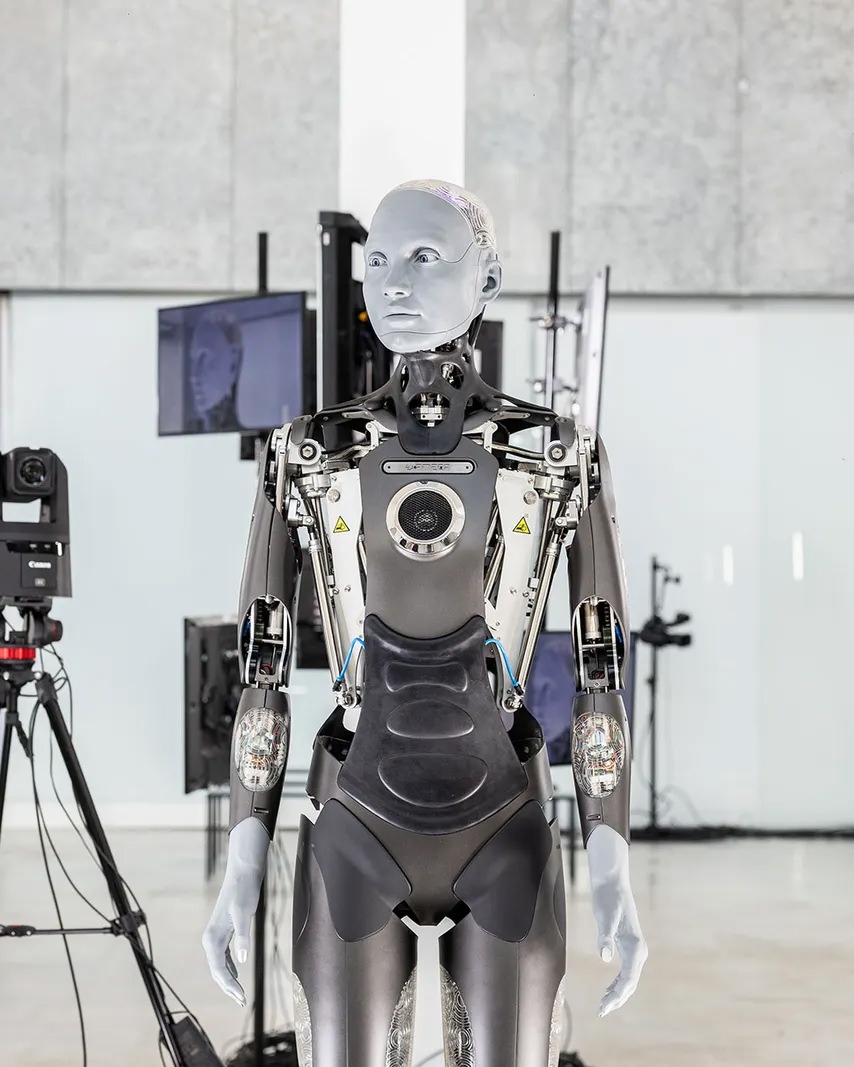
A mobile, AI-driven social humanoid used in research, high-end hospitality, and entertainment.
Engineered Arts is a UK robotics company headquartered in Falmouth, Cornwall, focused on social humanoid robots built for public engagement - museums, brand activations, education, and research - where expressive communication matters as much as mobility. A key differentiator is its in-house software platform Tritium, a secure, cloud-based suite used to create, customize, operate, and manage its humanoids, including tools for fleet oversight and content/behavior workflows.
Its best-known robot is Ameca, a full-size, fully programmable humanoid designed for entertainment, education, and engagement, with 61 degrees of freedom - including a highly expressive face and articulated arms, hands, neck, and torso for natural interaction.
For smaller installations, Ameca Desktop brings the same design language and expressive performance to a compact format.
The company also offers Mesmer, a social humanoid optimised for exceptionally lifelike face-to-face interaction, and RoboThespian, a long-running “performer” platform used for scripted shows and interactive exhibits.
Ami Desktop adds a head-and-shoulders tabletop robot aimed at entertainment, education, and research scenarios that benefit from expressive dialogue at close range.
In terms of “currently available” (for social interaction or demos) Engineered Arts has the current line-up: Ameca, Ameca Desktop, Ami Desktop, and select Mesmer models.
Looking ahead, its “future robots” are tightly tied to Tritium’s roadmap, especially Tritium AI, a cloud service intended to give these humanoids richer, more natural conversational abilities and faster content iteration across fleets.
For UK and EU Organisations, Engineered Arts is most relevant to experience centres, universities, exhibitions, hospitality, healthcare simulation, research and public-facing innovation environments. TRG can help assess whether a social humanoid is the right fit or whether an industrial humanoid platform would be more suitable.